
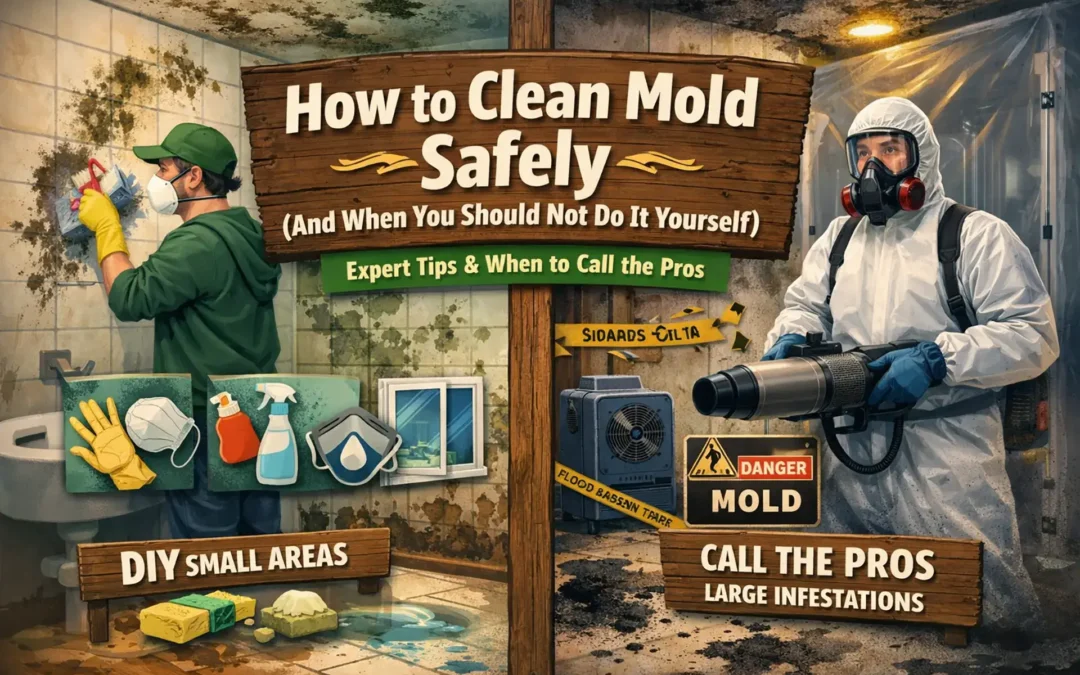
Finding mold in your home can be stressful. Many people search online because they want a fast and safe way to clean it. The truth is that some mold can be cleaned at home, but many mold problems should be handled by professionals.
This guide explains how to clean mold safely, when it is okay to do it yourself, and when calling a professional is the smarter choice.
What Causes Mold in Homes
Mold grows where there is moisture. It does not appear by accident. The most common causes are water leaks, high humidity, poor ventilation, flooding or past water damage, and condensation that forms on walls or pipes.
Because of these conditions, mold is often found in bathrooms, basements, crawl spaces, laundry rooms, and around windows. If the moisture problem is not fixed, mold usually comes back even after it has been cleaned.
Is It Safe to Clean Mold Yourself
You can usually clean mold yourself when the affected area is small, the mold is limited to a hard surface, there is no strong musty smell, and the mold has not returned before. In these cases, the problem is often only on the surface.
You should not try to clean mold yourself if it keeps coming back, covers an area larger than a few square feet, or is growing on wood or drywall. Mold should also not be cleaned without professional help if the home has had flooding or water damage, or if you feel sick when you are around the mold.
Knowing the difference can help you avoid spreading mold through your home and creating a bigger problem.
How to Clean Mold Safely at Home
To clean mold safely, wear gloves and a mask, ventilate the area, clean only small surface mold on non porous materials, and dry the area completely. Never mix cleaning products and never scrub mold on porous surfaces.
Basic safety steps:==
- Wear gloves and a mask
- Open windows or use a fan
- Keep children and pets away
Clean only visible mold on hard surfaces like tile or sealed surfaces. Dry the area fully after cleaning. Moisture left behind can cause mold to return quickly.
How to Clean Mold Off Walls
Mold on walls can be cleaned if the surface is non porous, such as tile or painted surfaces without damage. If the wall is soft or stained, professional help is recommended.
Steps:
- Lightly clean the surface without soaking it
- Avoid scrubbing drywall
- Dry the wall completely
If the paint is bubbling or the wall feels soft, mold is likely growing inside the wall. Cleaning the surface will not fix the problem.
How to Clean Mold Off Wood
Mold on wood is difficult to clean because wood absorbs moisture. If mold appears on wood, it often means deeper growth that requires professional treatment.
Why wood is risky:
- Mold grows inside the wood
- Scrubbing can release spores
- Mold often returns after cleaning
Surface cleaning may improve appearance, but it does not remove mold deep inside the wood. This is one of the most common reasons mold problems come back.
How to Clean Mold in a Shower or Bathroom
Shower mold can be cleaned if it is limited to grout or tile and proper ventilation is added. Mold that returns often points to airflow or moisture problems.
Common problem areas:
- Shower corners
- Grout lines
- Caulk
Cleaning helps, but adding a working exhaust fan and reducing humidity is just as important. Without airflow, mold will return no matter how often you clean.
Why Black Mold Is More Dangerous
Black mold is risky because disturbing it can release spores into the air. Cleaning it without containment may spread mold to other parts of the home.
Black mold is often found after leaks or flooding. It spreads easily and should not be scrubbed or vacuumed. Professional containment and air filtration are the safer option.
Signs You Should Stop Cleaning and Call a Professional
You should call a professional if you notice that mold keeps coming back after cleaning or if there is a strong musty odor in the home. Mold found in basements or crawl spaces is also a sign of a deeper moisture problem. If mold appears after flooding or water damage, cleaning the surface is usually not enough.
Health symptoms such as coughing, headaches, or irritation when you are around mold are another warning sign. These issues often mean that mold is growing beyond the surface and needs professional attention.
Why Professional Mold Cleanup Is Safer
Professional mold cleanup is not just about removing mold. It is about stopping it from returning.
Professionals:
- Contain mold to prevent spread
- Filter the air during removal
- Remove affected materials safely
- Identify and fix the moisture source
Without fixing moisture, mold will continue to grow no matter how often it is cleaned.
How Zavza Seal Handles Mold the Right Way
Zavza Seal approaches mold by fixing the real problem, not just the surface damage.
Our process includes:
- Careful inspection
- Moisture source identification
- Safe mold removal
- Long term prevention
Mold is often linked to basement leaks, crawl space moisture, or poor drainage. Fixing these issues protects the home and the people inside it.
How to Prevent Mold From Coming Back
Preventing mold means controlling moisture.
Helpful steps include:
- Fixing leaks quickly
- Using dehumidifiers
- Improving ventilation
- Sealing foundation cracks
- Waterproofing basements and crawl spaces
Prevention is always easier and cheaper than repeated cleanup.
Common Mold Cleaning Mistakes to Avoid
Many mold problems get worse because of simple mistakes. Mixing cleaning products can create harmful fumes and does not make mold easier to remove. Scrubbing porous surfaces like wood or drywall can spread mold spores into the air instead of removing them.
Ignoring hidden moisture allows mold to continue growing behind walls or under floors. Painting over mold only covers the problem for a short time and often leads to faster regrowth. These actions usually spread mold instead of solving the issue.
Frequently Asked Questions About Mold Cleaning
Can vinegar kill mold?
Vinegar may clean surface mold but does not remove mold roots inside materials.
Does bleach kill mold?
Bleach can lighten stains but does not kill mold inside porous surfaces.
Is mold always dangerous?
Small surface mold may not be harmful, but ongoing mold growth is a health risk.
How much mold is too much?
If mold keeps returning or covers more than a small area, professional help is recommended.
Final Thoughts
Cleaning small mold spots can be safe in some cases. But mold is often a sign of a bigger moisture problem. When mold returns or spreads, cleaning alone is not enough.
Professional mold cleanup protects your home, your air quality, and your long term health. Fixing the moisture source is the only real solution.
If mold keeps coming back, it is time to stop cleaning and start fixing the problem correctly.