
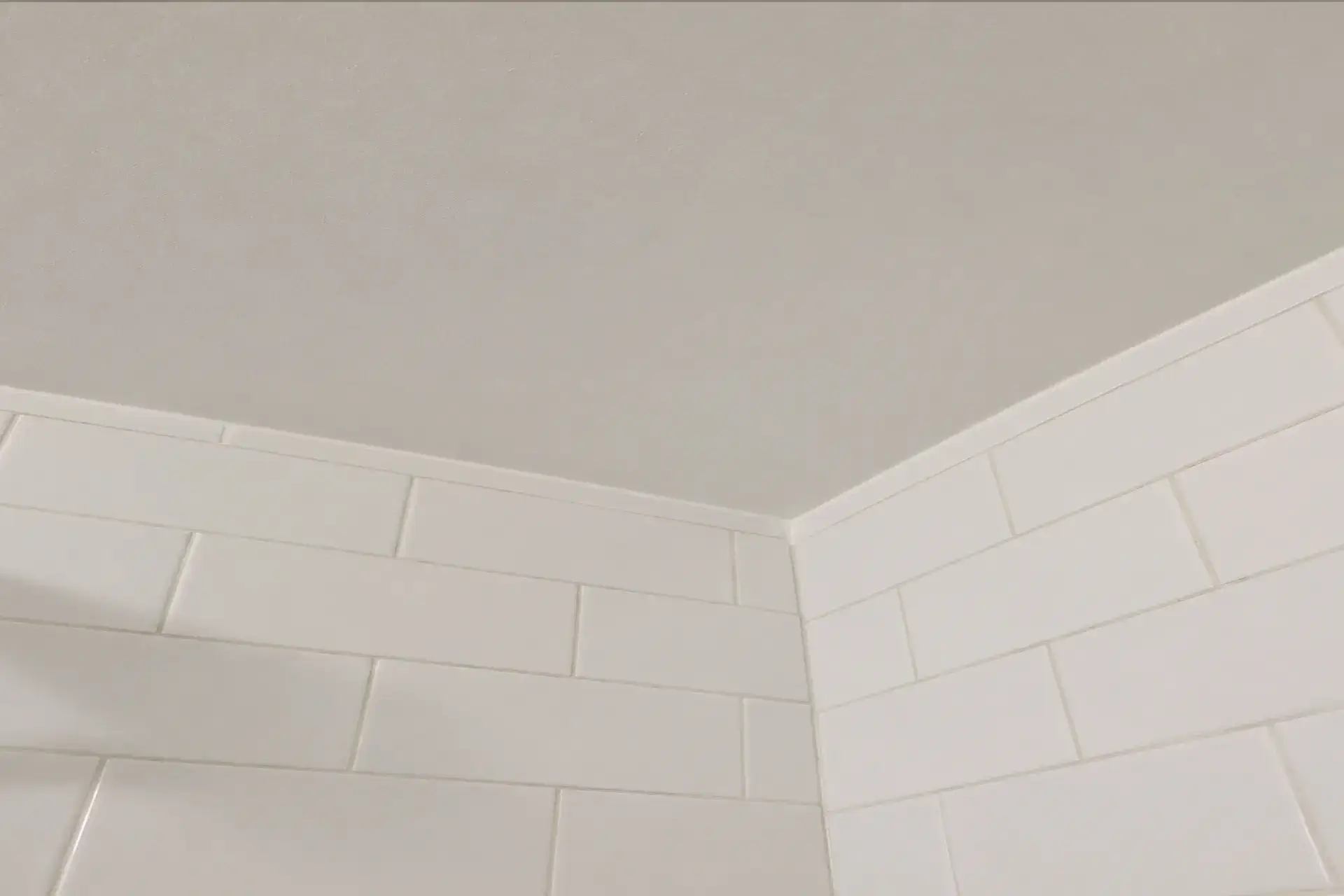
Professional Mold Remediation and Basement Restoration in Bethpage, NY
Mold can spread quickly when moisture is allowed to remain inside a home. It not only damages building materials but can also affect indoor air quality and create an unhealthy living environment. When mold is discovered, it is important to identify both the contamination and the source of the moisture to help prevent it from returning.
Our team at Zavza Seal recently completed a mold remediation project in Bethpage, NY. The homeowner had discovered mold growth in the basement living room and bathroom after noticing staining on the ceiling and walls. Our goal was to safely remove the mold, improve indoor air quality, repair the damaged areas, and eliminate the moisture source that allowed the mold to grow.
The Problem
The homeowner contacted Zavza Seal after seeing mold on the bathroom ceiling and several basement walls. Some areas of the sheetrock showed visible staining, while other sections had begun to deteriorate due to prolonged moisture exposure.
During our inspection, our NY State Licensed Mold Abatement Supervisor reviewed the affected areas and determined that professional mold remediation was necessary. Mold contamination had spread throughout portions of the basement living room and bathroom, making proper containment essential to prevent spores from spreading to the rest of the home.
Our inspection also identified leaking pipes in the bathroom and boiler room. These leaks had created the moisture conditions that allowed mold to develop behind finished surfaces. Simply cleaning the visible mold would not have solved the underlying problem.
Our Solution
Before any demolition began, our crew prepared the work area following professional mold remediation procedures.
Every technician wore disposable protective suits, gloves, and eye protection while working inside the containment area. Furniture and other belongings were carefully cleaned and removed from the work zone to protect them during the remediation process.
We installed heavy-duty 6 mil plastic containment barriers at the entrance to completely isolate the affected areas. This helped keep mold spores and construction dust from spreading into other parts of the home.
To improve air quality during the project, we operated commercial three-stage negative air scrubbers equipped with H13 HEPA filters. The machines ran continuously for three days and nights, creating negative air pressure while filtering airborne mold spores from the work area.
Once containment was complete, we performed a fine mist application throughout the affected areas to help suppress dust and reduce airborne mold spores before removing contaminated materials.
Our team then removed approximately the bottom two feet of damaged sheetrock in the basement living room, along with all mold-contaminated drywall in the bathroom. Every contaminated material was carefully sealed inside plastic bags before being removed from the home.
After demolition, we wire brushed and sanitized all affected framing and structural surfaces where needed. Non-porous materials, including ceramic tile, the bathtub, and bathroom fixtures, were cleaned using an environmentally friendly disinfectant designed to remove mold and mildew while remaining non-irritating and odor-free.
Additional antimicrobial cleaning agents were applied to selected surfaces to provide a thorough cleaning. The entire work area, including the walls, ceilings, and floors, was then cleaned using professional HEPA vacuums to capture any remaining dust or mold particles.
Where appropriate, we applied a water-based fungicidal protective coating to exposed structural surfaces. This coating helps discourage future mold growth while providing long-term protection in areas that had previously been affected by moisture.
With the remediation complete, our team installed new sheetrock, taped the joints, and applied compound to restore the finished walls.
Before closing the walls, we also repaired the leaking pipes in both the bathroom and boiler room. Correcting these leaks was an important part of the project because controlling moisture is one of the most effective ways to help prevent mold from returning.
The Result
The basement living room and bathroom were safely restored to a clean and healthy condition.
The mold-contaminated materials were removed, the affected surfaces were thoroughly cleaned and sanitized, and the damaged walls were rebuilt with new sheetrock ready for the homeowner’s finishing touches.
Just as importantly, the plumbing leaks that contributed to the mold growth were repaired before the project was completed. By addressing both the mold and its moisture source, the homeowner now has greater confidence that the basement will remain cleaner, healthier, and better protected against future mold problems.
Why Professional Mold Remediation Is Important?
Mold is often more extensive than what is visible on the surface. It can grow behind drywall, above ceilings, and inside wall cavities where moisture remains trapped.
Professional remediation focuses on safely containing contaminated areas, removing damaged materials, cleaning affected surfaces, and controlling airborne spores during the process. Just as important, identifying and correcting the source of moisture helps reduce the risk of future mold growth.
Attempting to simply paint over mold or wipe the surface clean without correcting the moisture problem often leads to the mold returning.
At Zavza Seal, every mold remediation project begins with a careful inspection so we can safely remove contamination while helping homeowners prevent future problems through proper moisture control and repairs.
Need Mold Remediation in Bethpage, NY?
If you have noticed mold growth, musty odors, water damage, or moisture problems in your basement or bathroom, Zavza Seal can help.
Our experienced team provides professional mold remediation, moisture control, basement restoration, and water damage repair services throughout Bethpage, Long Island, and the surrounding communities. We focus on restoring healthy indoor environments by treating both the mold and the conditions that allow it to grow.