
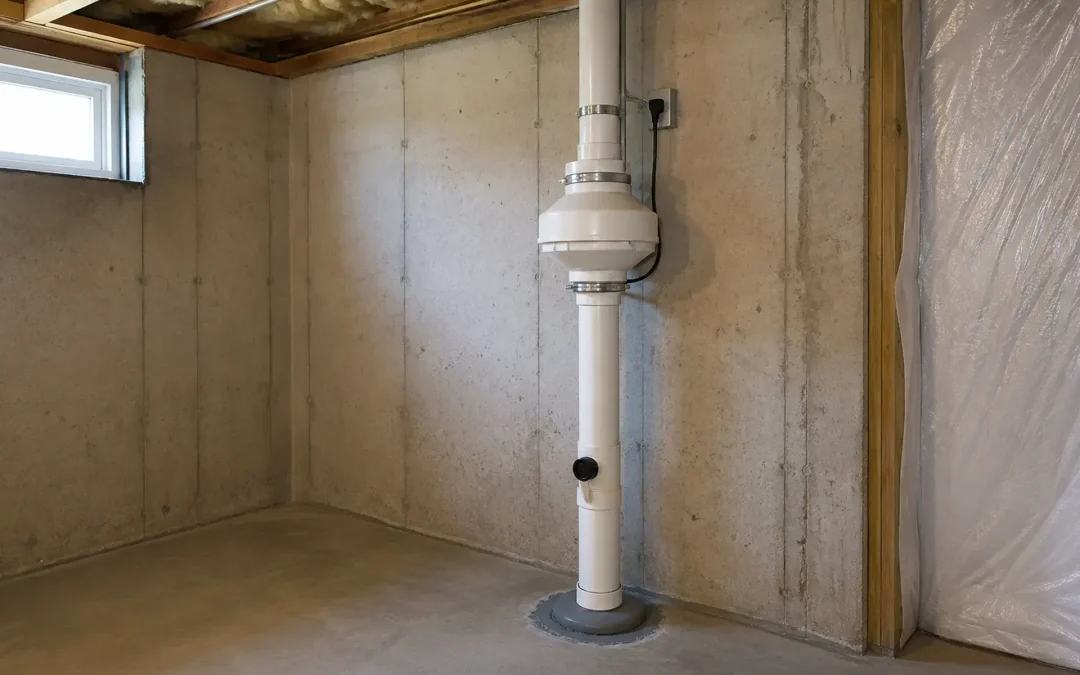
If a radon test shows elevated levels in your home, the next question is usually simple: How does a radon mitigation system actually work?
In basic terms, a radon mitigation system pulls radon-containing soil gas from beneath the home and vents it outside before it can build up indoors. The most common approach for homes with concrete slabs is sub-slab depressurization, which uses a suction point, vent pipe and fan to move soil gas away from the house.
The exact system depends on the home’s foundation, basement or crawl space and how soil gas is moving beneath the building.
How Does Radon Get Into a House?
Radon is a naturally occurring gas found in soil and rock. It can enter a home through openings between the building and the ground.
Common entry points include cracks in concrete floors and foundation walls, construction joints, gaps around pipes and sump pits. Pressure differences between the soil and the home can also draw soil gas indoors.
You cannot see or smell radon, so testing is the only way to know whether your home has elevated levels.
If you want to learn more about radon, its health risks and when testing is recommended, see our guide to [radon mitigation].
How Does a Radon Mitigation System Work?
Think of a radon mitigation system as giving soil gas a controlled way out of the house.
For a typical basement with a concrete slab, a contractor creates a suction point beneath the slab. A pipe is connected to that point and routed outside. A fan creates suction, drawing soil gas from beneath the home into the pipe. The gas is then discharged outdoors where it can disperse.
The process is straightforward:
Soil gas → suction point → vent pipe → fan → outdoors
The goal is to reduce the pressure beneath the home so radon is pulled away from the foundation instead of being drawn into the living space.
What Are the Main Parts of a Radon Mitigation System?
A typical active system has a few basic components.
The suction point collects soil gas from beneath the foundation. The vent pipe carries the gas outside, while the radon fan creates the suction needed to move it. A warning device or pressure indicator can help show whether the system is operating properly.
Sealing materials may also be used around appropriate cracks and openings. However, sealing alone is not necessarily a complete radon mitigation solution. The purpose of an active system is to actively remove soil gas from beneath the building.
What Is Sub-Slab Depressurization?
Sub-slab depressurization is one of the most common radon mitigation methods for homes with basements or slab-on-grade foundations.
A suction pipe is installed through or beneath the concrete slab and connected to a fan. The fan pulls radon-containing soil gas from below the slab and vents it outdoors.
The number and location of suction points depend on the home and how easily air can move through the soil or aggregate beneath the slab. Some homes may need only one suction point, while others require more.
That is why a radon mitigation system should be designed for the individual property rather than installed as a standard package.
Do All Homes Use the Same Radon Mitigation System?
No. The home’s foundation plays a major role in choosing the right approach.
A basement with a concrete slab may use sub-slab suction. A home with a crawl space may require a different method, such as suction beneath a sealed membrane. Some homes may also use existing drainage features or sump areas as part of the mitigation design when appropriate.
The condition of the foundation matters too. Cracks, joints, sump pits and openings around pipes may need to be addressed as part of the overall work.
Does Sealing Cracks Stop Radon?
Sealing cracks and openings can help reduce potential pathways for radon to enter a home, but it should not automatically be treated as a complete mitigation system.
For example, sealing a crack in a basement floor can close one possible entry point. But radon may still be entering from beneath the slab through other pathways.
This is why radon sealing and active radon mitigation are different things. Sealing can be part of the solution, while an active mitigation system uses suction to remove soil gas from beneath the home.
How Is a Radon Mitigation System Installed?
The installation starts with understanding the home’s radon test results and foundation.
The contractor determines where the suction point should go, installs the necessary piping and connects the system to a radon fan. The vent pipe is then routed to an appropriate outdoor termination point.
The system should be checked after installation, and the home should be tested again to confirm that radon levels have been reduced. New York State recommends working with a qualified radon mitigation contractor and maintaining the system after installation.
How Do You Know If a Radon Mitigation System Is Working?
You should be able to check the system’s warning device or pressure indicator to make sure it is operating properly. The fan also needs to remain in working condition.
But the most important confirmation is radon testing.
A running fan does not, by itself, prove that the indoor radon level has been reduced enough. EPA recommends retesting at least every two years to make sure levels remain low.
If the post-installation result is still elevated, the system may need to be evaluated and adjusted.
Real-Life Example: Basement Sealing and Radon Protection in Northport, NY
A Zavza Seal project in Northport, NY shows how basement repair and sealing can address potential pathways for radon entry.
The homeowner had persistent water intrusion through an approximately 850-square-foot basement floor. The slab had about 50 linear feet of visible cracks, along with water seepage around the joint where the foundation wall met the floor.
Zavza Seal scarified the basement floor, prepared and repaired the cracks with Basecrete waterproofing cement, and reinforced the perimeter joint with fiberglass mesh. As the final step, a radon concrete sealer was applied across the basement floor according to the manufacturer’s instructions.
The finished basement had a repaired and sealed floor with reinforced perimeter joints.
This project is also a good example of why it is important to be precise about radon work. Sealing a basement floor can reduce potential pathways for radon entry, but it is not the same as installing an active radon mitigation system. If testing shows elevated radon, the home should be evaluated to determine whether an active system is needed.
How Much Does a Radon Mitigation System Cost?
There is no single price for every home. The cost depends on the foundation, number of suction points, pipe routing, fan, accessibility and any sealing or preparation required.
New York State notes that mitigation costs vary based on the technique, materials and extent of the work. The state also recommends getting estimates and references before choosing a contractor.
Need Radon Mitigation in Long Island, Brooklyn, Queens or the Bronx?
If your home has elevated radon, the right solution starts with understanding the building rather than simply installing a pipe and fan.
Zavza Seal works with homeowners across Long Island, Brooklyn, Queens and the Bronx, including properties with basements, crawl spaces, foundation issues and concrete slab concerns.
We can evaluate the conditions affecting your lower level and help determine what type of work may be appropriate for your property.
[Learn more about Zavza Seal’s radon mitigation services →]
Frequently Asked Questions
Does a radon mitigation system remove radon?
It reduces indoor radon by drawing radon-containing soil gas away from the home and venting it outdoors.
Does a radon fan run all the time?
Active systems are generally designed to operate continuously. The system should be monitored and maintained to make sure the fan continues to work properly.
Can a radon mitigation system be installed in a finished basement?
Yes. The system can often be designed around an existing finished space, although pipe routing and suction-point placement need to be considered carefully.
Can a sump pit be used for radon mitigation?
In some homes, a sump area can be incorporated into a radon reduction system. Whether it is appropriate depends on the property’s construction and existing drainage setup.
How long does a radon mitigation system last?
A properly installed system can operate for many years. The fan may eventually need repair or replacement, so regular checks and radon testing are important.
Sources & Standards
This article is based on guidance from the U.S. Environmental Protection Agency (EPA) and the New York State Department of Health (NYSDOH), including their guidance on radon reduction systems, soil suction, system maintenance and qualified mitigation contractors.
New York State also points homeowners toward recognized professional proficiency programs and industry standards, including AARST/NRPP and NRSB credentials and ANSI/AARST mitigation standards.
Recommended sources:
U.S. EPA Radon Resources
New York State Department of Health Radon Program
New York State Radon Mitigation Guidance