
The Problem: Water Entering the Basement Near a Downspout
The property had water intrusion in an area near the downspout intake PVC pipe.
During the initial inspection, the project manager considered excavating the exterior foundation wall. A French drain was not an option for this property, so exterior excavation was one possible approach.
Before recommending a larger repair, the project manager reviewed the site conditions and photos again and determined that the water intrusion was more likely connected to the downspout intake PVC pipe.
The connection between the pipe and the surrounding concrete appeared to be allowing water to reach the foundation area.
There was also a possibility that the PVC pipe itself was cracked or damaged. Although this was considered less likely, the project manager planned to conduct tests and probes during the work to check the condition of the pipe.
The Solution: Targeted Repair Around the Downspout Intake
Instead of immediately excavating the entire exterior foundation wall, Zavza Seal focused on the area around the downspout intake pipe.
The goal was to strengthen the area around the pipe and create a proper seal to reduce the path for water intrusion.
1. Temporarily Dismantling the Fence
The fence near the affected area was temporarily dismantled to give the crew access to the downspout intake pipe and surrounding foundation.
The fence was to be reinstalled after the waterproofing work was completed.
2. Excavating Around the Downspout
The area was excavated as necessary to provide enough access for the repair.
This allowed the team to work around the pipe and prepare the area for the new concrete structure.
During this stage, the project manager could also examine the pipe and perform tests and probes to determine whether there was any damage to the PVC.
3. Installing a Reinforced Concrete Retaining Wall
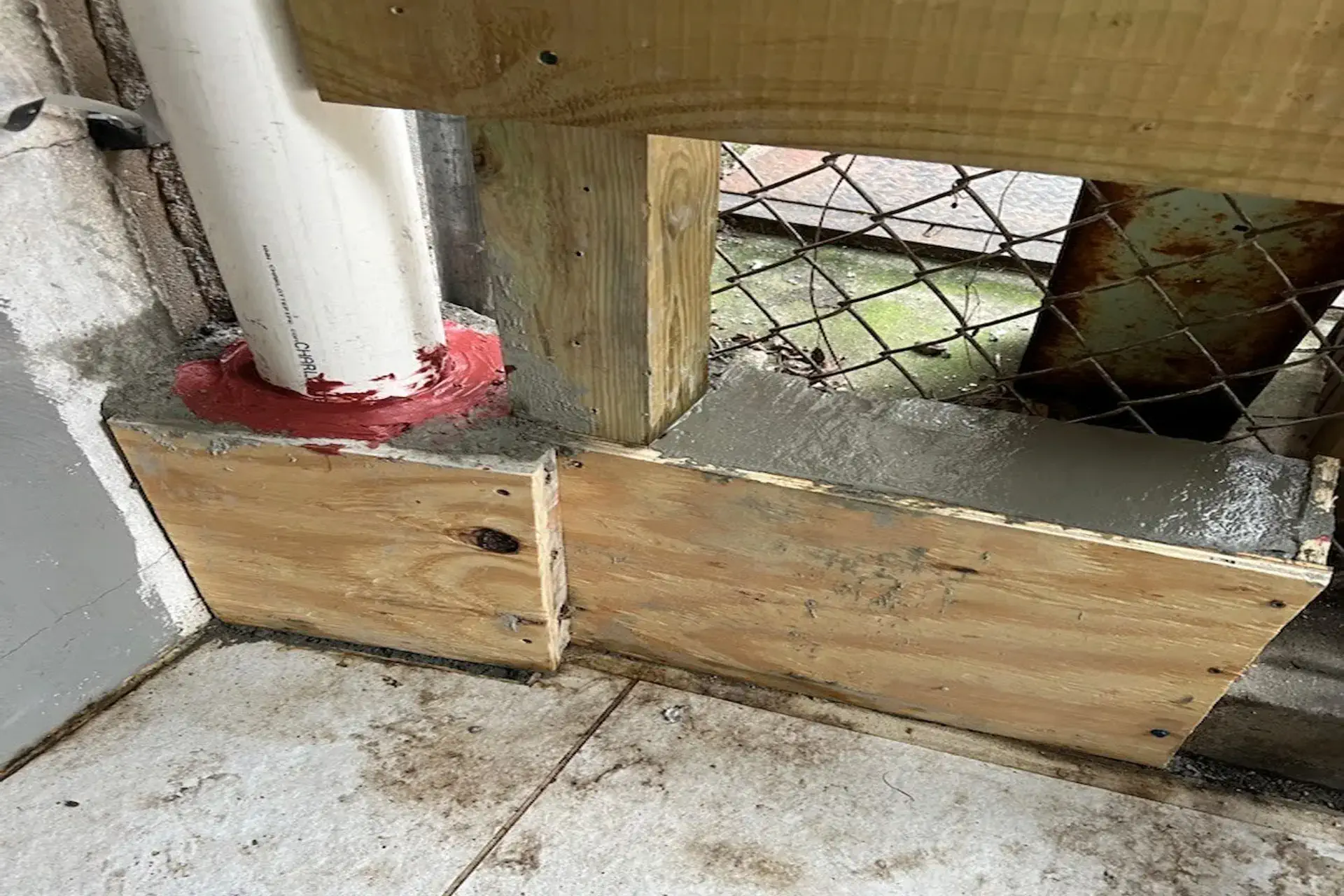
Zavza Seal installed a concrete retaining wall with a reinforced footing around the affected area.
The reinforced footing provided a stable base for the concrete structure and helped strengthen the repair area.
4. Installing a Concrete Belt Around the Pipe
The team installed a concrete belt around the PVC downspout intake pipe.
This helped close the area around the pipe and created a stronger transition between the pipe and the surrounding concrete.
5. Sealing the Pipe Connection
Zavza Seal injected SikaSwell S-2 between the concrete and the PVC pipe.
This material was used to help seal the connection and provide additional protection against water entering through the space around the pipe.
6. Applying 6,000 PSI Waterproofing Cement
The team completed the repair by applying 6,000 PSI waterproofing cement to the affected area.
This provided an additional layer of protection around the downspout intake and surrounding concrete.
Additional Water Testing Revealed Another Problem
While implementing the original scope of work, Zavza Seal’s project manager conducted water testing to determine whether there were additional paths for water to enter the basement.
The southwest corner of the property was flooded for approximately 15 minutes.
During the test, water entered the basement interior.
This showed that there were additional waterproofing problems that needed to be investigated.
The team found large holes in the foundation walls that created additional points of potential water intrusion. These areas were identified by the red arrows in the project exhibits.
Because these openings were not part of the original suspected downspout problem, an additional repair scope was developed.
The Additional Solution: Repairing the Foundation Holes
Zavza Seal developed a targeted repair for the large foundation openings.
1. Filling the Foundation Holes With Repair Mortar
The team applied 6,500 PSI repair mortar inside the foundation holes.
The mortar was pushed deeply into the cavities to fill the openings rather than simply covering the surface.
This helped address the deeper voids within the foundation wall.
2. Sealing Between the Concrete and Foreign Material
After filling the cavities, Zavza Seal injected a sealant between the existing concrete and the foreign material inside the openings.
This helped seal the transition and provide additional protection against water passing through the repaired areas.
Why Water Testing Mattered?
This project shows why it is important to identify the source of water before deciding on a major foundation repair.
The initial investigation focused on the downspout intake pipe. After reviewing the site conditions, the project manager identified the pipe connection as the more likely source of the original water intrusion.
Then, during the repair, controlled water testing revealed that the property had additional problems.
Flooding the southwest corner for approximately 15 minutes resulted in water entering the basement. Further investigation uncovered large holes in the foundation walls.
The additional findings allowed Zavza Seal to address more than just the original suspected source.
The Result:
Zavza Seal’s work focused on the areas identified during the inspection and water testing.
The original repair addressed the improperly installed downspout intake pipe with a reinforced concrete retaining wall, concrete belt, SikaSwell S-2 and 6,000 PSI waterproofing cement.
Additional foundation holes discovered during water testing were addressed with 6,500 PSI repair mortar and sealant.
The project demonstrated the importance of inspecting the full water intrusion pathway instead of assuming that the first visible problem is the only source of a basement leak.