
The Problem:
The homeowner needed a better way to manage water in the backyard. The existing drainage setup was not enough to handle the amount of water reaching the area.
Instead of allowing water to collect on the surface, the project called for a large underground dry well that could collect stormwater and allow it to gradually infiltrate into the surrounding soil.
Dry wells are commonly used as underground stormwater infiltration systems. They can help manage runoff where a traditional storm drain is not available or practical. The New York State Department of Environmental Conservation includes dry wells among the stormwater infiltration practices used to manage runoff.
For this Long Island property, Zavza Seal was brought in to construct a 1,200-gallon backyard dry well designed around the available space and project requirements.
The Solution:
Zavza Seal’s team carefully planned the excavation and construction of the new dry well.
The first step was to saw-cut the existing concrete in the work area. This allowed the crew to open the required section without unnecessarily disturbing the surrounding backyard.
The excavation was then expanded deep and wide enough to accommodate the new dry well.
The completed dry well measured approximately:
- 80 inches long
- 80 inches wide
- 44 inches deep
- 1,200-gallon capacity
Building the Dry Well:
Once the excavation was prepared, the crew began building the underground structure.
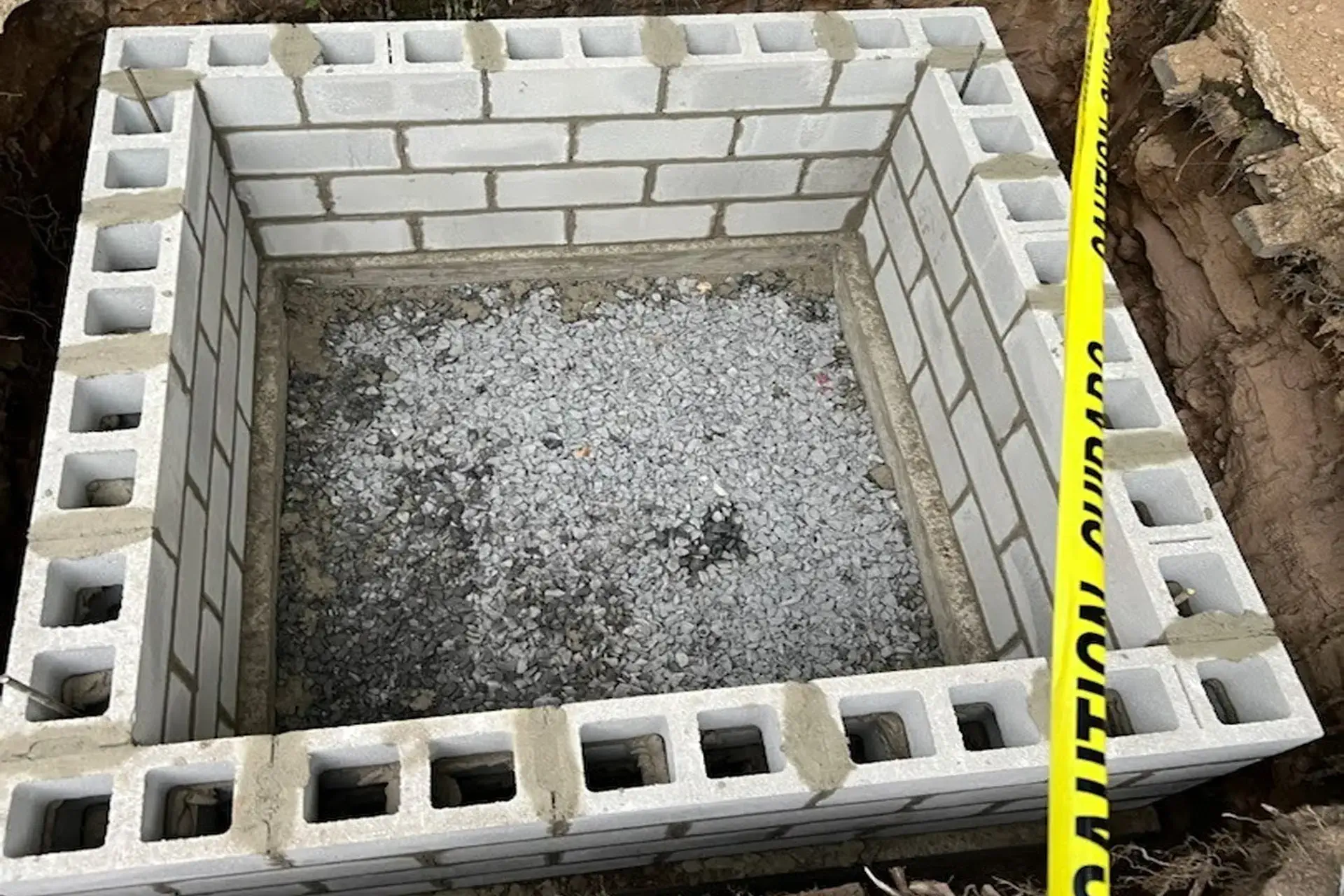
A 12-inch by 12-inch steel wire reinforced footing was installed to provide a solid base for the cinder block walls.
Next, the team placed a 12-inch gravel bed inside the footing. The gravel provides space for water to collect and move into the surrounding soil.
Cinder block walls were then installed on top of the reinforced footing.
After the structure was completed, Zavza Seal installed a 3-inch reinforced concrete slab over the dry well. The area was then backfilled to restore the backyard surface.
Preparing the Backyard for Future Hardscape:
One important part of the project was planning for how the homeowner might finish the backyard in the future.
If the homeowner decides to install concrete, pavers or another hardscape, the dry well can be equipped with a dome cast iron grate drain.
The heavy-duty grate provides a durable drainage point while helping prevent leaves and dirt from blocking the opening.
If the backyard remains in its existing condition, the dry well can instead remain completely buried underground without a grate drain.
This gave the homeowner flexibility without requiring the drainage system to be rebuilt later.
Careful Debris Removal:
The work area presented another challenge. Because of the property’s layout, debris had to be removed manually using buckets and carried through the house.
There was no alternative access route for removing the excavated material.
Zavza Seal’s crew took precautions throughout the project to keep the work organized and reduce disruption to the homeowner. Debris was removed as the work progressed rather than being left around the property.
The Result:
The completed project provided the Long Island homeowner with a new 1,200-gallon underground dry well designed to manage stormwater in the backyard.
The project included:
- Saw-cutting of the existing concrete
- Excavation for the dry well
- Installation of a 12″ x 12″ steel wire reinforced footing
- Installation of a 12″ gravel bed
- Construction of cinder block walls
- Installation of a 3″ reinforced concrete slab
- Backfilling of the excavation
- Planning for a future cast iron grate drain
- Manual debris removal through the house
- Final cleanup of the work area
A properly designed dry well must take local soil and site conditions into account. New York State guidance notes that dry wells should be properly separated from structures and designed according to the site’s infiltration conditions.
For this reason, a dry well should not be treated as a one-size-fits-all drainage solution. The size, location, construction and drainage conditions should be evaluated for each property.