
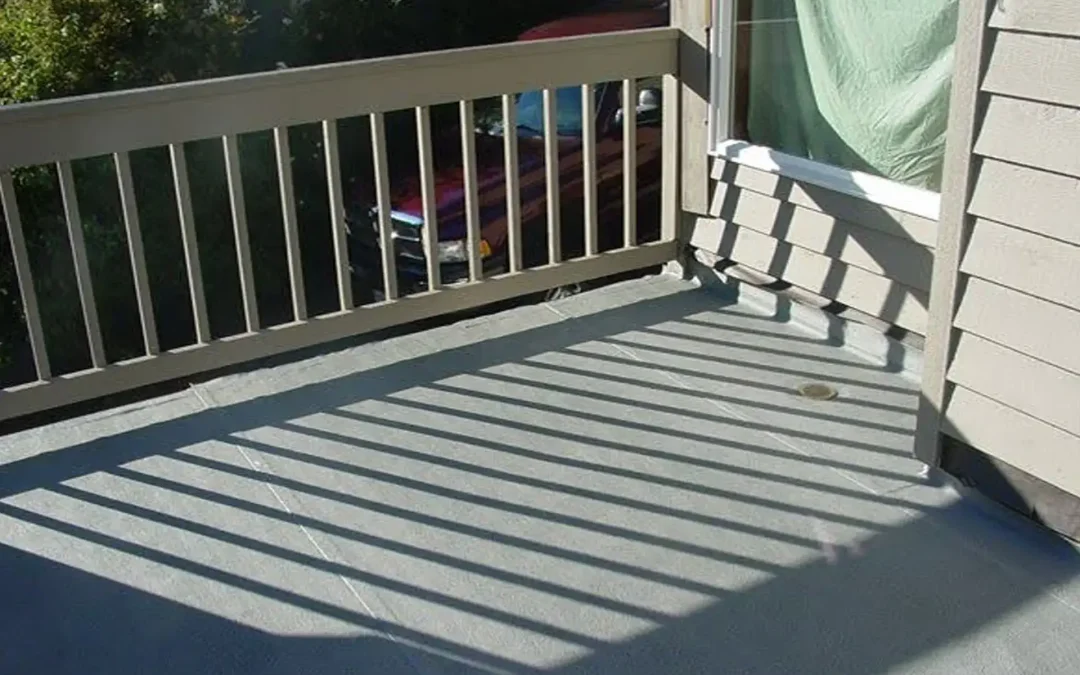
Expansion joints may look like simple gaps in a deck, but they serve an important structural purpose. They allow adjoining sections of a structure to move slightly as temperatures change, materials expand and contract, and the building experiences normal movement. The challenge is that the same opening that allows movement can also provide an easy pathway for rainwater, snowmelt, and moisture.
For deck waterproofing contractors Brooklyn property owners work with, expansion joints are therefore treated as critical waterproofing details rather than ordinary cracks that can simply be filled. The objective is to preserve the joint’s ability to move while creating a reliable barrier against water.
That process involves much more than spreading sealant over a visible opening. Proper joint preparation, material compatibility, flexible waterproofing products, membrane transitions, drainage, and ongoing inspection all play a role. In many situations, the condition of the surrounding waterproofing system is just as important as the expansion joint itself.
So, how exactly do contractors keep water out without restricting the movement the joint was designed to accommodate? The answer lies in understanding both sides of the problem: structural movement and water management.
Why Deck Expansion Joints Need Special Waterproofing Attention
Expansion joints are designed to move, while waterproofing systems are expected to remain continuous and watertight. That creates a natural challenge.
Imagine a raincoat with a flexible elbow section. The sleeve has to bend, stretch, and move with your arm, but it still needs to keep rain out. Expansion-joint waterproofing works on a similar principle.
A rigid material might block water effectively when everything is stationary, but when the joint opens and closes repeatedly, that rigid material can crack or pull away. A properly designed joint detail, on the other hand, combines flexibility with adhesion and water resistance.
This is why expansion joints require purpose-built waterproofing methods rather than ordinary crack fillers.
What an Expansion Joint Does
An expansion joint separates sections of a structure so they can respond independently to changes in temperature, moisture, loading, and normal building movement.
Concrete decks, balconies, rooftop terraces, parking structures, and other exposed surfaces can experience dimensional changes throughout the year. When those movements are concentrated in an uncontrolled way, cracking and other forms of damage can occur.
The joint itself is not a defect. It is an intentional part of the structure.
The waterproofing challenge is making sure that the joint continues to perform its structural function while preventing moisture from traveling into the materials beneath the deck.
Why Water Finds Its Way Into Joints
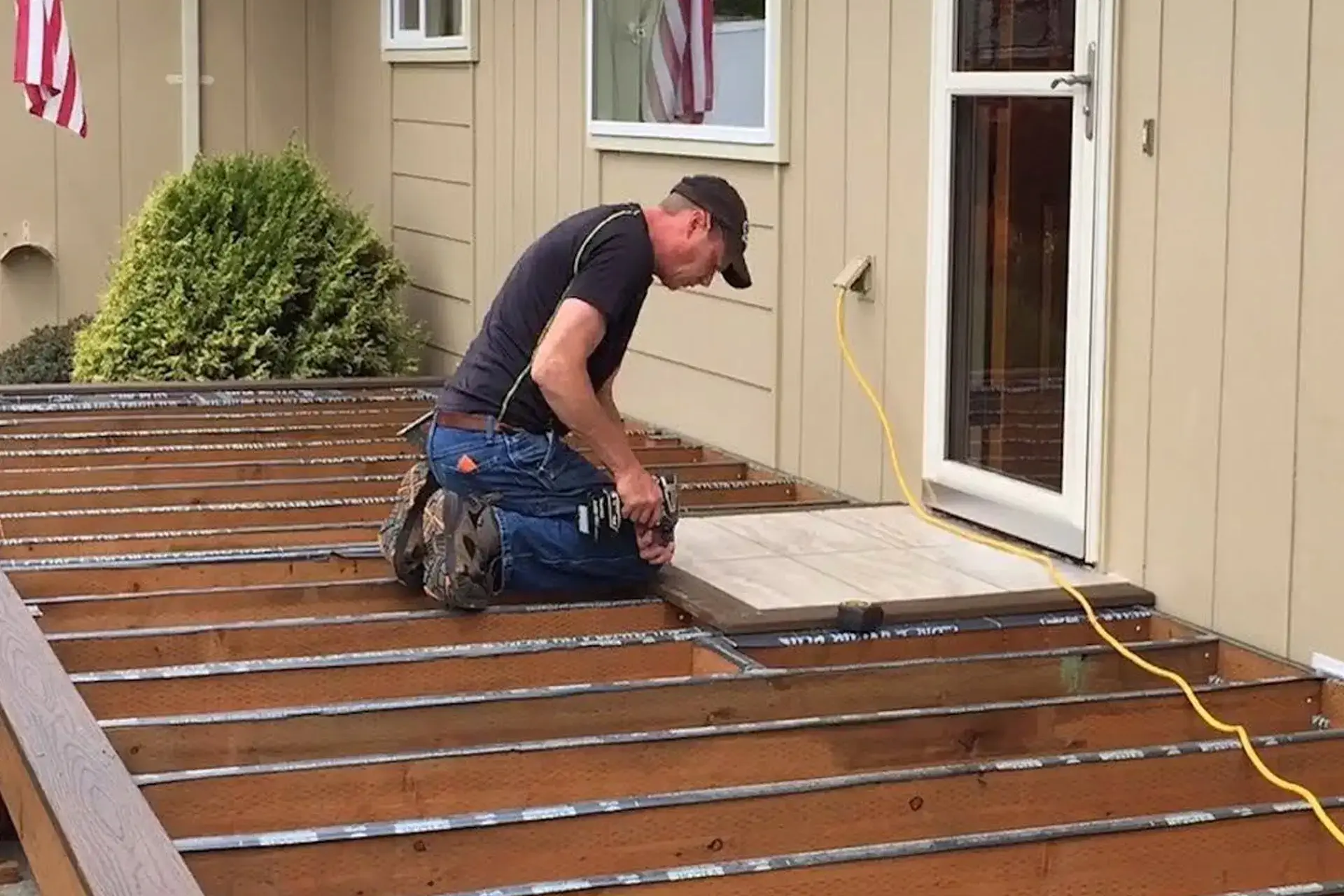
Water is remarkably persistent. It follows gravity, exploits tiny openings, and can travel through narrow pathways that may not be obvious from the surface.
At an expansion joint, water may enter because the sealant has cracked, the bond between sealant and substrate has failed, or the waterproofing membrane has deteriorated near the joint. Water can also move underneath a membrane when the transition detail is improperly installed.
That makes visual inspection alone somewhat unreliable. A joint may appear mostly intact while hidden deterioration is already allowing moisture into the deck assembly.
Common Causes of Water Intrusion at Deck Expansion Joints
Expansion-joint leaks rarely happen for just one reason. A combination of movement, weather exposure, aging materials, installation problems, drainage issues, and poor repairs can weaken the joint over time.
Understanding the cause matters because replacing the visible sealant without addressing the underlying problem can result in another failure.
Seasonal Expansion and Contraction
Temperature changes cause many building materials to expand and contract.
During warm weather, concrete and other materials can expand. During colder conditions, they contract. That repeated movement places stress on joint sealants and nearby waterproofing materials.
A flexible, properly installed sealant can absorb much of that movement. A brittle material or poorly bonded sealant may crack, split, or separate from the joint edge.
This is one reason expansion-joint protection has to account for movement over time rather than simply focusing on how the joint looks on the day of installation.
Joint Sealant Deterioration
Sealants are exposed to sunlight, rain, snow, temperature fluctuations, and physical movement. Eventually, even quality materials can begin to deteriorate.
Common warning signs include:
- Cracking
- Shrinkage
- Hardening
- Loss of adhesion
- Separation from joint edges
- Surface deterioration
- Tearing within the sealant
Once those defects develop, water can enter the joint and travel deeper into the deck assembly.
Improper Drainage and Ponding Water
Poor drainage can increase stress on expansion joints.
When water remains standing on the deck, the joint stays wet for longer periods. This increases the amount of moisture available to exploit even small defects.
Blocked drains, insufficient slope, deteriorated surfaces, debris accumulation, and localized depressions can all contribute to ponding.
Waterproofing should therefore be viewed as part of a complete water-management system. Sealing the joint is important, but directing water away from it is equally valuable.
How Deck Waterproofing Contractors Evaluate Expansion Joints
A good waterproofing repair usually begins with diagnosis.
Rather than immediately applying new sealant, contractors may evaluate the condition of the joint, measure its dimensions, inspect the surrounding membrane, examine the substrate, review drainage patterns, and look for signs of moisture below the deck.
This approach helps determine whether the visible failure is the actual problem or merely a symptom of something larger.
For example, a cracked sealant bead could result from excessive joint movement, inadequate preparation, deteriorated concrete edges, incompatible materials, or improper joint configuration.
Fixing only the visible crack may not solve the real issue.
Checking Joint Width and Movement
Joint dimensions influence how waterproofing materials perform.
Contractors may inspect whether the joint has a consistent width and whether the concrete or other substrate along the edges is sound. Irregular openings can make it harder for sealants to respond predictably to movement.
The joint also needs an appropriate depth and configuration for the selected waterproofing material.
A sealant that is installed too thickly or too deeply may not flex as intended. Conversely, an installation that is too shallow may lack durability.
Inspecting Adjacent Waterproofing Membranes
An expansion joint does not exist by itself.
It connects to the rest of the deck waterproofing system, which may include membranes, coatings, drainage components, walls, curbs, railings, doors, and other penetrations.
If the surrounding membrane is cracked, lifted, or poorly bonded, water may bypass the joint even when the sealant itself looks acceptable.
That is why a thorough inspection evaluates the entire transition zone rather than focusing only on the center of the joint.
Signs of Hidden Moisture
Water intrusion is not always immediately visible.
Possible indicators include staining beneath the deck, damp insulation, peeling finishes, corrosion around metal components, efflorescence on concrete or masonry, recurring dampness, or moisture that appears after rainfall.
None of these signs automatically proves that an expansion joint is the source. However, they can indicate that a deeper investigation is warranted.
Waterproofing Methods Used Around Expansion Joints
There is no single waterproofing method that works for every deck expansion joint.
The appropriate system depends on the joint design, expected movement, substrate, surrounding waterproofing materials, environmental exposure, and manufacturer’s specifications.
Despite those differences, the central principle stays the same: the waterproofing detail must prevent water intrusion without restricting necessary movement.
Flexible Joint Sealants
Flexible sealants are commonly used because they can stretch and compress as a joint moves.
Depending on the application, contractors may use polyurethane, silicone, or other elastomeric materials. The choice should be based on factors such as movement capability, substrate compatibility, adhesion, weather resistance, and the existing waterproofing system.
The fact that a product is labeled waterproof does not automatically make it suitable for an expansion joint.
Reinforcing and Bridging Systems
Some waterproofing assemblies incorporate reinforcement around joint areas.
Reinforcement may help distribute stress and support transitions between different materials. It can be particularly useful where the waterproofing system needs to bridge a complicated joint detail.
However, reinforcement must be integrated correctly.
If a reinforcing layer is too rigid or installed without sufficient flexibility, it can become another stress concentration and eventually crack or detach.
Waterproof Membrane Terminations
Where a waterproofing membrane approaches an expansion joint, the termination must be carefully designed.
Depending on the system, this may involve reinforced liquid-applied transitions, mechanical terminations, prefabricated components, or specialized joint assemblies.
The objective is to prevent water from getting underneath or around the membrane while still allowing the joint to function.
The specific installation should follow the technical requirements of the selected waterproofing system.
Backer Rods and Bond-Breaking Materials
Backer rods are often used to help control sealant depth and create the intended sealant configuration.
One of their important functions is to prevent the sealant from bonding to the bottom of the joint where a two-sided bond is required. This allows the sealant to stretch and contract more predictably.
Without proper joint geometry, even an otherwise high-quality sealant may be forced to handle movement in ways it was never designed to accommodate.
How Contractors Prevent Water From Bypassing the Joint
Water does not always travel directly through the center of an expansion joint.
It can move around poorly detailed edges, beneath membranes, or through nearby penetrations. That means joint waterproofing has to address the entire surrounding area.
Proper transitions, sound substrates, compatible materials, controlled drainage, and correct membrane detailing all help create a continuous water-resistant barrier.
The best waterproofing detail is not simply a patch over an opening. It is a coordinated system.
Proper Surface Preparation
Surface preparation is one of the most important steps in waterproofing installation.
Dust, dirt, loose concrete, oil, deteriorated sealant, laitance, and moisture can interfere with adhesion.
Depending on the condition of the deck, contractors may remove failed materials, clean the joint faces, repair damaged concrete, and prepare the substrate according to the requirements of the selected system.
A premium product cannot compensate for a poorly prepared surface.
Controlling Joint Geometry
Sealant performance is closely connected to joint shape.
Width, depth, backing materials, and the location of sealant adhesion all influence how movement is distributed.
An overly deep application may limit flexibility. An overly shallow application may reduce durability.
For that reason, contractors generally follow the manufacturer’s specified joint dimensions instead of relying on visual judgment alone.
Protecting Transitions and Penetrations
Expansion joints are often located near other vulnerable areas, including walls, railings, posts, doors, drains, and curbs.
Each transition creates another possible route for moisture.
A well-sealed expansion joint can still leak if a nearby penetration is left poorly waterproofed.
The surrounding details therefore need to be considered as part of the same moisture-control strategy.
Materials Commonly Used for Expansion Joint Waterproofing
Different waterproofing materials offer different advantages.
Material selection should consider expected movement, weather exposure, substrate compatibility, UV exposure, durability, and integration with the existing deck waterproofing system.
Choosing the right material is less about finding the most expensive product and more about selecting a system that fits the conditions.
Polyurethane Sealants
Polyurethane sealants are commonly used in construction because many formulations offer strong adhesion combined with flexibility.
They can be suitable for concrete and masonry applications when the correct product is selected and installed properly.
Performance still depends on surface preparation, joint configuration, curing conditions, and primer requirements where applicable.
Silicone-Based Sealants
Silicone sealants are known for flexibility and resistance to weather and ultraviolet exposure.
Some formulations are especially useful where significant joint movement is expected.
However, silicone is not automatically appropriate for every deck. Compatibility with adjacent materials and the existing waterproofing system should be confirmed before installation.
Liquid-Applied Waterproofing Systems
Liquid-applied waterproofing can create seamless protective layers around difficult areas.
These systems may be useful for complicated transitions, irregular shapes, and areas where reinforcement is required.
Their performance depends heavily on substrate preparation, application thickness, curing conditions, reinforcement details, and adherence to installation specifications.
Why Local Conditions Matter on Brooklyn Decks
Environmental conditions have a direct effect on exposed waterproofing systems.
For Brooklyn properties, deck assemblies may experience rainfall, snow, seasonal temperature changes, freezing conditions, sunlight, debris, and repeated wet-dry cycles.
These conditions do not automatically dictate one particular waterproofing product, but they are important considerations when evaluating material performance and maintenance needs.
Freeze-Thaw Cycles and Moisture
Water can enter porous concrete and other materials through very small openings.
When temperatures drop below freezing, trapped water can freeze and expand. Repeated freeze-thaw exposure can contribute to deterioration in already damaged materials.
Keeping water out of joints and surrounding deck components can therefore reduce one source of moisture-related stress.
Rain, Snow, and Urban Exposure
Urban decks are exposed to a wide range of environmental conditions.
Rain and snow introduce moisture, while leaves and debris can interfere with drainage. Nearby buildings, paved surfaces, and other structures can also influence how water reaches and remains on a deck.
Regular inspection becomes particularly useful after major storms or during periods of seasonal change.
What Homeowners and Property Managers Should Look For
Property owners do not need specialized equipment to notice early warning signs.
A simple visual inspection can reveal changes that deserve further attention.
Looking at expansion joints after heavy rain can sometimes reveal areas where water is pooling, sealants are separating, or membranes are lifting.
Visual Warning Signs
Watch for:
- Cracked or missing sealant
- Gaps along joint edges
- Peeling or blistered waterproofing
- Membrane separation
- Water staining below the deck
- Rust or corrosion near metal components
- Persistent dampness
- Standing water
- Deteriorated concrete along joint edges
One symptom may not identify the cause, but several signs together can indicate a developing waterproofing problem.
When Joint Repairs May Not Be Enough
Sometimes the expansion joint is only part of the problem.
If the surrounding waterproofing membrane has deteriorated, if the concrete edge has become damaged, or if drainage is poor, simply replacing the sealant may not provide lasting protection.
In that situation, the repair may need to address a wider portion of the waterproofing system.
The objective should be to correct the source of moisture intrusion rather than repeatedly patching the same visible defect.
The Role of Professional Installation
Expansion-joint waterproofing requires attention to details that are easy to overlook.
The person performing the work needs to understand joint movement, material limitations, substrate condition, sealant geometry, waterproofing transitions, drainage, and compatibility between products.
Technical installation requirements matter because even an excellent material can fail when it is installed over a contaminated substrate, used in an unsuitable configuration, or bonded in the wrong locations.
Coordinating Joint and Deck Waterproofing
One of the biggest principles in expansion-joint protection is coordination.
The joint sealant, membrane, reinforcement, drainage components, edge details, and surrounding surfaces should function together.
A joint can be properly sealed at the center and still leak at the perimeter if the surrounding waterproofing is poorly integrated.
That is why the joint should be considered part of the complete deck waterproofing assembly.
Why Compatibility Between Materials Matters
Deck waterproofing systems can contain multiple products, including sealants, primers, membranes, coatings, reinforcement fabrics, concrete repair materials, metals, and backing materials.
These components need to be compatible.
Incompatible materials can result in poor adhesion, premature cracking, softening, staining, or other performance problems.
Reviewing technical data and manufacturer requirements before combining products is an important part of professional waterproofing work.
How Deck Waterproofing Contractors Brooklyn Approach Joint Protection
When evaluating an expansion joint, deck waterproofing contractors in Brooklyn property owners may begin with investigation rather than immediate repair.
The process can involve evaluating the joint condition, checking movement, examining the substrate, inspecting nearby waterproofing, reviewing drainage, removing failed materials, preparing the surface, and installing a flexible waterproofing detail suited to the application.
This sequence matters because waterproofing tends to perform best when the underlying cause of failure has been identified first.
The goal is not merely to make the joint look sealed.
The goal is to create a detail capable of handling repeated movement while remaining resistant to rain, snow, and moisture over time.
Role of Zavza Seal LLC in Waterproofing Discussions
Zavza Seal LLC can be discussed in relation to deck waterproofing and expansion-joint protection, but the technical principles behind effective waterproofing remain broader than any individual company.
From an informational perspective, the important questions are straightforward.
How is joint movement being accommodated? Is the substrate properly prepared? Are the waterproofing materials compatible? Is the membrane correctly integrated with the joint? Is drainage adequate? Are nearby penetrations and transitions protected?
These technical considerations provide a more useful framework for evaluating waterproofing work than relying solely on promotional descriptions.
Long-Term Maintenance of Waterproofed Expansion Joints
Even a properly installed expansion-joint system benefits from periodic inspection.
Sealants should be checked for cracking, debonding, shrinkage, and loss of flexibility. Nearby waterproofing membranes should also be examined for punctures, lifting, bubbling, and deterioration.
Drainage systems should remain clear so water does not accumulate around vulnerable areas.
Periodic inspections are especially useful because small defects are often easier to address before moisture reaches concealed materials below the deck.
Maintenance is not necessarily about constant repair. It is about noticing changes early enough to prevent a manageable issue from becoming a major waterproofing problem.
Zavza Seal LLC Serving the Midwood Community and Beyond in Brooklyn
Zavza Seal LLC is dedicated to serving the diverse needs of the local community of Brooklyn, including individuals residing in neighbourhoods like Midwood. With its convenient location near landmarks such as the Chase Bank and major intersections like E12th St and Avenue J (coordinates: 40.6247016, -73.963846), we offer deck waterproofing contractors services.
Get deck waterproofing contractors services at Midwood Now
Call Us or Contact Us: +17184007005
Navigate from Midwood to Zavza Seal LLC Now
Protecting a deck expansion joint from water intrusion is a balancing act. The joint has to remain flexible enough to move while also functioning as a reliable barrier against moisture.
That requires more than applying a bead of sealant across a visible opening. Proper surface preparation, joint geometry, flexible materials, backing systems, waterproof membrane transitions, compatible products, and effective drainage all influence the long-term performance of the detail.
For Brooklyn decks, seasonal weather and repeated moisture exposure make these considerations particularly important. Understanding how expansion-joint waterproofing works can help homeowners and property managers recognize warning signs, understand repair recommendations, and evaluate whether a visible leak is actually part of a larger waterproofing issue.
Safeguarding Structural Integrity: The Critical Role of Expansion Joint Waterproofing
- The Invisible Threat: Expansion joints are essential structural gaps allowing for thermal movement and settling, yet they represent a building’s most vulnerable points for water intrusion .
- The Cost of Neglect: Without professional waterproofing, water infiltration leads to the corrosion of steel reinforcement and concrete spalling, turning minor maintenance tasks into six-figure structural repair crises .
- The Modern Standard: Industry-leading solutions—including specialized polyurethane sealants, pre-compressed foam systems, and advanced injection technologies—now provide flexible, long-term seals designed to move with the building’s lifecycle .
- Strategic Protection: Professional inspection every 3 to 5 years remains the primary defense, preventing systemic failure and preserving property value through planned maintenance rather than reactive, emergency repairs.
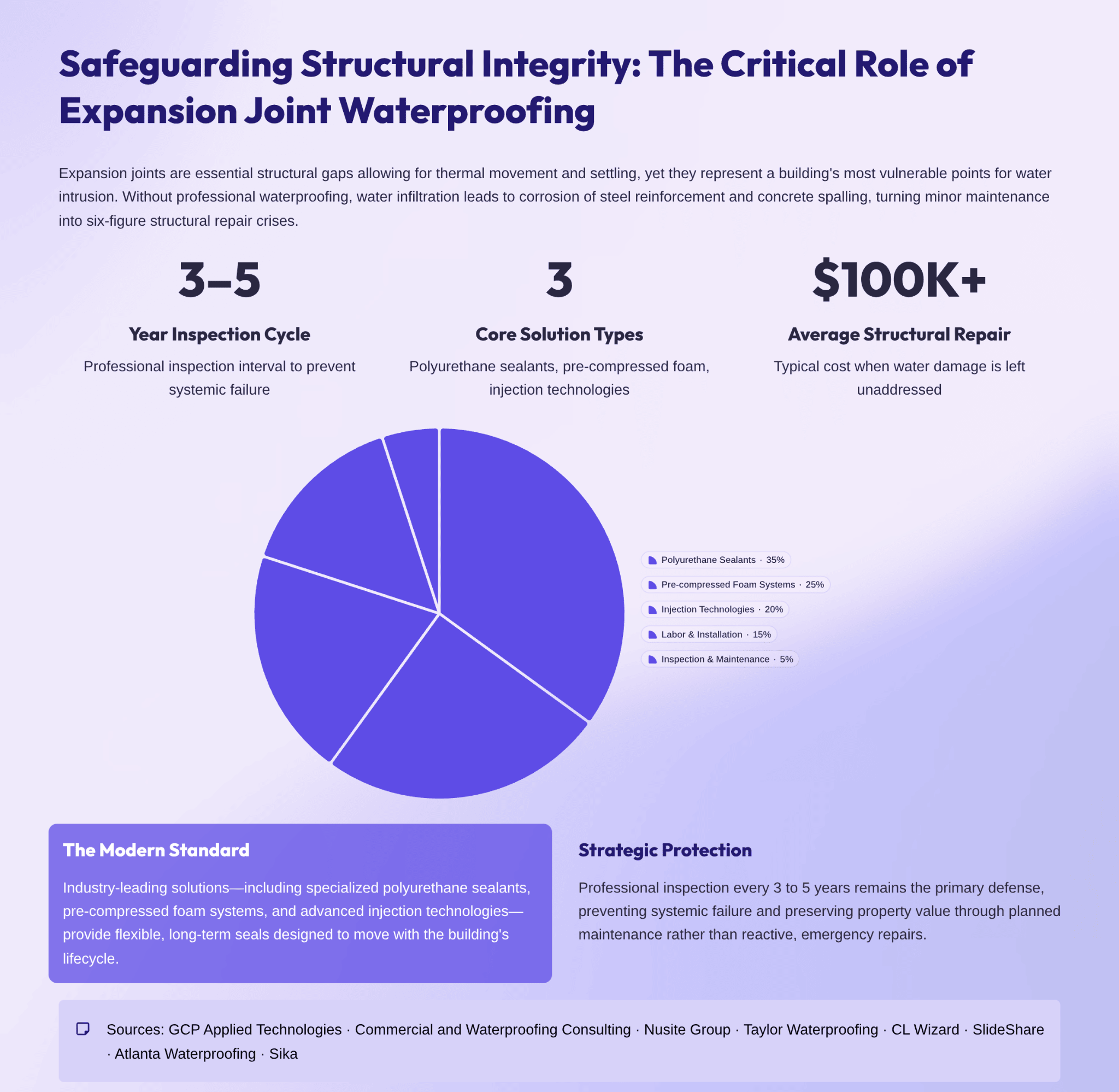
Sources: GCP Applied Technologies , Commercial and Waterproofing Consulting , Nusite Group , Taylor Waterproofing , CL Wizard , SlideShare , Atlanta Waterproofing , Sika
FAQs
Why do deck expansion joints leak?
Expansion joints can leak because of failed sealant, poor adhesion, incorrect joint geometry, excessive movement, damaged concrete, deteriorated waterproofing membranes, or inadequate drainage. Water can also bypass the joint through nearby transitions and penetrations.
Can a cracked expansion-joint sealant simply be replaced?
Sometimes. If the surrounding substrate and waterproofing system are still in good condition, replacing failed sealant may be an appropriate repair. However, if the joint has underlying membrane damage, deteriorated concrete, poor drainage, or another related defect, a more comprehensive repair may be necessary.
Why is flexible sealant important for expansion joints?
Expansion joints are specifically designed to accommodate movement. A flexible sealant can expand and contract with the joint more effectively than a rigid material, helping maintain a continuous barrier against water.
How often should deck expansion joints be inspected?
There is no single inspection schedule that applies to every deck. Inspection frequency depends on the age of the structure, exposure, traffic, waterproofing system, climate, and maintenance history. However, periodic inspections and checks after severe weather can help identify problems early.
Do expansion-joint leaks always mean the entire deck waterproofing system has failed?
No. A leak can sometimes be limited to the joint itself. However, the surrounding membrane, substrate, drainage system, and nearby transitions should be evaluated before assuming the problem is isolated. A visible joint defect can sometimes be a symptom of a broader waterproofing issue.