
A roof does not have to develop a large hole before water finds its way inside. In many cases, moisture enters through much smaller openings, especially around roof seams, joints, flashing, penetrations, and connections between different roofing materials.
Roof seams deserve particular attention because they are points where two sections of roofing meet. Even when those sections are securely installed, the connection can experience movement, temperature changes, weather exposure, and gradual material deterioration.
This is where roof waterproofing becomes important.
Rather than simply covering a visible leak, waterproofing is designed to create a continuous barrier that limits the ability of water to pass through vulnerable areas. Depending on the roofing system, this may involve sealants, liquid-applied membranes, reinforcing fabrics, seam tapes, coatings, or combinations of these materials.
For property owners researching roof waterproofing services brooklyn, understanding how these systems work can make it easier to recognize potential problems before a small seam defect turns into extensive water damage.
Why Roof Seams Are Vulnerable to Water Intrusion
Roof seams are essentially transition points. One piece of roofing material ends, another begins, and the two have to remain connected while the roof moves beneath them.
That sounds simple, but roofs are constantly exposed to changing conditions.
A roof can heat up under direct sunlight, cool rapidly after sunset, become wet during a storm, freeze during winter, and experience repeated expansion and contraction throughout the year.
Every one of those changes places some degree of stress on seams.
How Roof Materials Expand and Contract
Most roofing materials change slightly with temperature.
Metal, for example, expands when heated and contracts when temperatures fall. Other roofing materials can also change dimensions or flexibility as temperatures fluctuate.
A properly designed roof system accounts for this movement. However, repeated movement can eventually place stress on sealants, fasteners, joints, and membrane connections.
Think of a roof seam like a joint in a bridge. It needs to remain connected while allowing controlled movement. If the connection becomes brittle or separates, water has an opening to exploit.
The Effect of Rain, Snow, and Ice
Rain is not always the only concern.
Snow can remain on a roof for extended periods, while melting snow may create prolonged moisture exposure around seams. In freezing conditions, water can enter a small opening and freeze.
When water freezes, it expands. That expansion can place additional pressure on an already weakened seam.
Repeated freeze-thaw cycles can therefore contribute to deterioration over time.
Why Small Seam Gaps Can Become Larger Problems
A seam does not need to have an obvious opening for water intrusion to begin.
A small crack in sealant, a partially separated membrane, or a deteriorated flashing connection may allow moisture to travel beneath the visible roof surface.
Once water gets underneath a roofing layer, it does not necessarily move straight downward.
It can travel horizontally along decking, insulation, framing, or other building materials before appearing inside the property.
That is one reason a ceiling stain may appear several feet away from the actual point where water entered.
What Happens When Water Gets Through a Roof Seam?
The first visible sign of a seam problem may be surprisingly minor. You might notice a small ceiling stain after a storm or a damp area near an exterior wall.
But the visible mark is not necessarily the full extent of the problem.
Water can remain trapped within roofing assemblies for extended periods, particularly when materials have limited ventilation or drying opportunities.
Damage to Roof Decking and Insulation
Roof decking provides structural support beneath many roofing systems.
If water repeatedly reaches the decking through a failed seam, the material may become damp and eventually deteriorate.
Insulation can also absorb or retain moisture depending on its composition. Wet insulation may lose some of its intended performance and can become part of a larger moisture problem.
Interior Ceiling and Wall Damage
Water that passes through a roof can eventually reach interior surfaces.
Common signs include:
- Brown or yellow ceiling stains
- Peeling paint
- Bubbling drywall
- Damp wall sections
- Warped interior materials
- Musty odors
- Recurring stains after rainfall
The key word is recurring.
If a stain appears after multiple storms, the underlying moisture source deserves investigation rather than simply repainting the affected area.
Conditions That Can Encourage Mold Growth
Moisture is one of the major factors associated with mold growth.
A roof leak does not automatically mean mold will develop, but prolonged dampness can create conditions that support microbial growth, particularly when moisture reaches organic materials and remains there.
This is another reason why controlling water at the roof level is preferable to dealing only with interior symptoms.
What Is Roof Waterproofing?
Roof waterproofing is a process used to reduce or prevent water penetration through vulnerable areas of a roofing system.
The exact approach depends on the roof’s construction, existing materials, slope, condition, drainage system, and location of the water-entry points.
Waterproofing may involve applying a protective membrane, sealing seams, reinforcing joints, treating penetrations, or creating a continuous waterproof coating over selected roof surfaces.
The goal is not simply to make the roof look sealed.
The waterproofing system must remain bonded and flexible enough to accommodate normal roof movement while resisting water exposure.
Waterproofing Versus Basic Roof Repair
These terms are sometimes used interchangeably, but they are not always the same.
A basic repair may address a specific defect, such as replacing damaged material or repairing a broken connection.
Waterproofing generally focuses on creating or restoring a broader moisture-resistant barrier.
For example, repairing one visibly damaged seam may solve an immediate defect. Waterproofing may involve inspecting surrounding seams, preparing the surface, reinforcing vulnerable areas, and applying a compatible waterproofing system.
The appropriate solution depends on the actual condition of the roof.
How Roof Waterproofing Services Seal Roof Seams
Professional waterproofing generally follows a sequence rather than simply applying material over the top of an existing problem.
Each stage matters because waterproofing materials perform differently depending on the surface beneath them.
Step 1: Inspecting the Roof and Seams
The first step is identifying where moisture may be entering.
An inspection can examine:
- Roof seams
- Flashing
- Penetrations
- Fasteners
- Membrane edges
- Drainage areas
- Existing coatings
- Previous repairs
- Visible cracks or openings
A useful inspection does not only search for the most obvious defect. It also considers how water may be traveling across the roof system.
Step 2: Cleaning and Preparing the Surface
Waterproofing materials need a suitable surface to bond properly.
Dirt, loose debris, old deteriorated sealant, grease, moisture, and loose roofing material can interfere with adhesion.
Surface preparation may therefore involve cleaning, drying, removing unstable materials, and preparing the seam for the selected waterproofing system.
Skipping this stage can undermine an otherwise high-quality waterproofing material.
Step 3: Repairing Existing Seam Damage
Waterproofing is not a substitute for every type of structural or roofing repair.
If a seam has significant separation, damaged substrate, loose materials, or other defects, those problems may need to be corrected before waterproofing is applied.
The principle is straightforward: a waterproofing layer should be applied over a sound surface whenever possible.
Covering an unstable problem does not necessarily eliminate it.
Step 4: Applying Waterproofing Materials
Once the seam has been prepared, the appropriate waterproofing material can be applied.
Different roofing systems require different approaches.
Liquid-Applied Waterproofing Membranes
Liquid-applied membranes are installed as a fluid material that cures into a continuous waterproof layer.
One major advantage is their ability to cover irregular areas and create a seamless surface when properly applied.
They can be useful around complicated transitions where traditional sheet materials may require multiple joints.
However, application thickness, surface preparation, curing conditions, and product compatibility all matter.
Seam Tapes and Reinforcement Fabrics
Some waterproofing systems use reinforcing fabrics or seam tapes to strengthen vulnerable joints.
The reinforcement becomes part of the waterproofing assembly rather than functioning as a standalone patch.
This can help distribute stress across the seam and reduce reliance on a narrow line of sealant.
Roof Coatings and Protective Layers
Roof coatings can create an additional protective layer over compatible roofing surfaces.
Depending on the product, coatings may help resist moisture, ultraviolet exposure, and weather-related deterioration.
Not every coating is suitable for every roof, though. Compatibility with the existing roofing material is an important consideration.
Step 5: Creating a Continuous Waterproof Barrier
The final objective is continuity.
Water does not care whether a seam was repaired yesterday. If there is an unsealed transition beside the repaired section, moisture may simply find another route.
A properly designed waterproofing system therefore considers the seam and its surrounding areas as part of one moisture-control assembly.
The fewer vulnerable breaks in that barrier, the fewer opportunities water has to enter.
How Waterproofing Materials Work at Roof Seams
Waterproofing materials are not all identical. Their performance depends on properties such as adhesion, flexibility, durability, chemical compatibility, and resistance to weather exposure.
Flexibility and Movement
Flexibility is particularly important around seams.
A material that becomes excessively brittle may crack as the roof moves.
A suitable waterproofing system needs enough flexibility to accommodate expected movement without losing its connection to the surrounding surface.
This does not mean the material should stretch indefinitely. It means the system should be appropriate for the type and degree of movement expected in that roofing assembly.
Adhesion to Roofing Materials
A waterproofing material must stay attached.
If the material loses adhesion, water can potentially travel underneath it.
This is why manufacturers specify surface conditions, primers, application temperatures, drying requirements, and compatible substrates.
Good adhesion begins before the waterproofing material is applied.
Resistance to Moisture and Weather Exposure
A roof waterproofing system must operate outdoors.
That means exposure to rain, sunlight, temperature fluctuations, wind, and seasonal weather.
UV exposure can gradually degrade some materials, while standing water can challenge systems that are not designed for prolonged ponding.
Choosing the correct system is therefore as important as applying it correctly.
Common Roof Seam Problems That Require Attention
Several types of defects can make seams more vulnerable to water intrusion.
Cracked or Deteriorated Sealant
Sealants can deteriorate over time.
They may become cracked, brittle, separated, or otherwise unable to maintain a reliable seal.
Simply adding a new layer of sealant over severely deteriorated material may not provide the same result as properly removing unstable material and preparing the surface first.
Separated Metal Panels
Metal roofs commonly contain seams between panels.
If panels shift, fasteners loosen, or seam components deteriorate, water may find a pathway through the connection.
The solution depends on why the separation occurred and how the roof was originally constructed.
Failed Flashing Connections
Flashing directs water around transitions, penetrations, edges, walls, chimneys, and other roof features.
A failed flashing connection can behave much like a failed seam.
Because flashing areas often involve several intersecting materials, they require careful inspection rather than a quick surface patch.
Punctures and Small Surface Openings
Small punctures may result from foot traffic, equipment installation, falling objects, or other physical impacts.
A puncture can become a direct entry point for water, particularly when it occurs near an existing seam or drainage area.
Why Proper Surface Preparation Matters
Imagine putting tape onto a dusty wall. It may stick for a while, but the bond is compromised from the beginning.
Roof waterproofing works on the same basic principle.
A waterproofing product can have excellent technical properties and still perform poorly if applied over loose, dirty, wet, or incompatible material.
Preparation may involve cleaning, drying, removing deteriorated sealant, repairing damaged substrate, and using primers where specified.
This step is often less visible than the finished coating, but it can have a major influence on long-term performance.
Roof Waterproofing for Different Roofing Materials
There is no universal waterproofing method that works identically across every roof.
Metal Roofing
Metal roofs often contain panel seams, fasteners, flashing, and penetrations.
Waterproofing systems for metal roofing may focus heavily on seam treatment, fastener areas, corrosion-related defects, and transitions.
Because metal moves with temperature changes, flexibility is particularly relevant.
Flat and Low-Slope Roofing
Flat and low-slope roofs require careful attention to drainage.
Water may remain on the surface longer than it would on a steep roof.
If seams are already compromised, prolonged moisture exposure can increase the risk of intrusion.
Waterproofing decisions should therefore consider both seam protection and drainage conditions.
Modified Bitumen and Membrane Roofs
Membrane-based roofs have their own seam characteristics.
Depending on the system, seams may be bonded, heat-welded, mechanically attached, or otherwise connected.
Waterproofing materials need to be compatible with the membrane and its existing surface condition.
Other Common Roofing Systems
Other roof types may include built-up roofing, single-ply membranes, asphalt-based systems, and specialized commercial assemblies.
Each system has different installation methods and maintenance requirements.
That is why the roofing material should be identified before selecting a waterproofing product.
How Brooklyn Weather Can Affect Roof Seams
Climate plays an important role in roof performance.
For properties in Brooklyn, roof systems experience a combination of seasonal conditions rather than one consistent environment.
Heavy Rain and Storm Conditions
Heavy rainfall can expose weak seams quickly.
Water may accumulate around low points, drains, penetrations, or other roof transitions.
When a seam already has a defect, intense rainfall can increase the amount of water reaching that vulnerable area.
Winter Freezing and Thawing
Brooklyn winters can introduce repeated freezing and thawing.
Water that reaches small cracks or openings may freeze and expand. When temperatures rise, the ice melts, leaving the area exposed to additional moisture.
Repeated cycles can contribute to gradual deterioration.
Summer Heat and UV Exposure
Summer brings a different challenge.
Strong sunlight and heat can increase the temperature of roof surfaces significantly.
UV radiation can also contribute to aging in certain roofing materials, sealants, and coatings.
A waterproofing system must therefore be able to handle both wet and dry conditions over its service life.
Signs That Water May Be Entering Through a Roof Seam
Roof seam leaks do not always announce themselves dramatically.
Sometimes the earliest signs are subtle.
Water Stains and Discoloration
A recurring brownish or yellowish ceiling mark can indicate moisture intrusion.
The location of the stain does not necessarily identify the exact roof entry point, because water can travel before reaching the interior surface.
Damp Insulation or Roofing Materials
Moisture within a roofing assembly may not be visible from inside the building.
During an inspection, damp materials can indicate that water has moved beyond the exterior roof surface.
Recurring Leaks After Rain
A particularly useful clue is timing.
If moisture consistently appears after rainfall, the roof should be evaluated for potential entry points.
The leak may originate from a seam, flashing, penetration, drainage problem, or another part of the roof assembly.
How Roof Waterproofing Differs From Replacing an Entire Roof
Waterproofing does not automatically mean that a roof is being completely restored or replaced.
A roof with localized seam problems may have substantial remaining serviceability.
In such cases, targeted repair and waterproofing may be considered as part of maintenance.
However, extensive structural deterioration, widespread membrane failure, severe material aging, or repeated unresolved leaks may indicate that more comprehensive work is necessary.
The important point is that waterproofing should be based on the actual condition of the roofing system rather than used as a universal solution.
How Long Does Roof Seam Waterproofing Last?
There is no single lifespan that applies to every waterproofing system.
Durability depends on several factors, including:
- Roofing material
- Waterproofing product
- Installation quality
- Surface preparation
- Weather exposure
- Roof movement
- Drainage
- Foot traffic
- Maintenance
- UV exposure
- Severity of existing damage
A waterproofing system installed correctly on a properly prepared surface can perform very differently from a quick application over deteriorated material.
Regular inspections are therefore important even after waterproofing has been completed.
How Roof Waterproofing Services Brooklyn Address Seam-Related Problems
When people search for roof waterproofing services brooklyn, the underlying concern is often more specific than simply wanting a waterproof roof.
They may be dealing with recurring leaks, aging seams, deteriorated sealants, roof penetrations, ponding water, or weather-related damage.
A proper waterproofing approach starts by identifying the source and understanding the existing roof assembly.
For example, Zavza Seal LLC may be considered in the context of roof waterproofing discussions, but the technical principles remain the same regardless of the contractor involved: inspect the roof, identify vulnerable areas, prepare the substrate, repair defects where necessary, select compatible materials, and create a continuous moisture-resistant barrier.
The important distinction is between applying a product and designing a waterproofing solution.
A coating by itself does not automatically solve every roofing problem.
The Role of Regular Roof Inspections
Roof inspections are one of the simplest ways to identify developing seam problems before they become major leaks.
An inspection can look for early signs such as:
- Cracked sealant
- Loose fasteners
- Open seams
- Deteriorated flashing
- Ponding water
- Surface cracking
- Damaged coatings
- Membrane separation
- Physical punctures
Timing also matters.
Inspections may be particularly useful after severe weather or before periods of heavy seasonal exposure.
The goal is not to wait until water reaches the ceiling.
Preventive inspection treats the roof as a system that needs monitoring rather than an object that only receives attention after it fails.
Zavza Seal LLC Serving the Mapleton Community and Beyond in Brooklyn
Zavza Seal LLC is dedicated to serving the diverse needs of the local community of Brooklyn, including individuals residing in neighbourhoods like Mapleton. With its convenient location near landmarks such as the smart care pharmacy and major intersections like E 9th St and Avenue J (coordinates: 40.6247016, -73.9668105), we offer roof waterproofing services services.
Get roof waterproofing services services at Mapleton Now
Call Us or Contact Us: +17184007005
Navigate from Mapleton to Zavza Seal LLC Now
Roof seams are among the most important areas to monitor because they connect different sections of a roofing system while remaining exposed to constant environmental stress. Temperature changes, rainfall, snow, ice, UV exposure, movement, and aging materials can gradually weaken these connections.
Roof waterproofing helps address this vulnerability by creating a protective moisture-resistant barrier around seams and other potential entry points. Depending on the roof, the process may involve surface preparation, seam repair, reinforcement, liquid-applied membranes, specialized sealants, tapes, or protective coatings.
The most effective approach is not simply to cover a leak. It is to understand why water is entering, determine how the roofing system is constructed, correct underlying defects, and use compatible waterproofing materials that can withstand expected movement and weather exposure.
For property owners considering roof waterproofing services in brooklyn, understanding these fundamentals provides a clearer picture of what proper seam protection involves and why preparation, material compatibility, drainage, and ongoing inspections all matter.
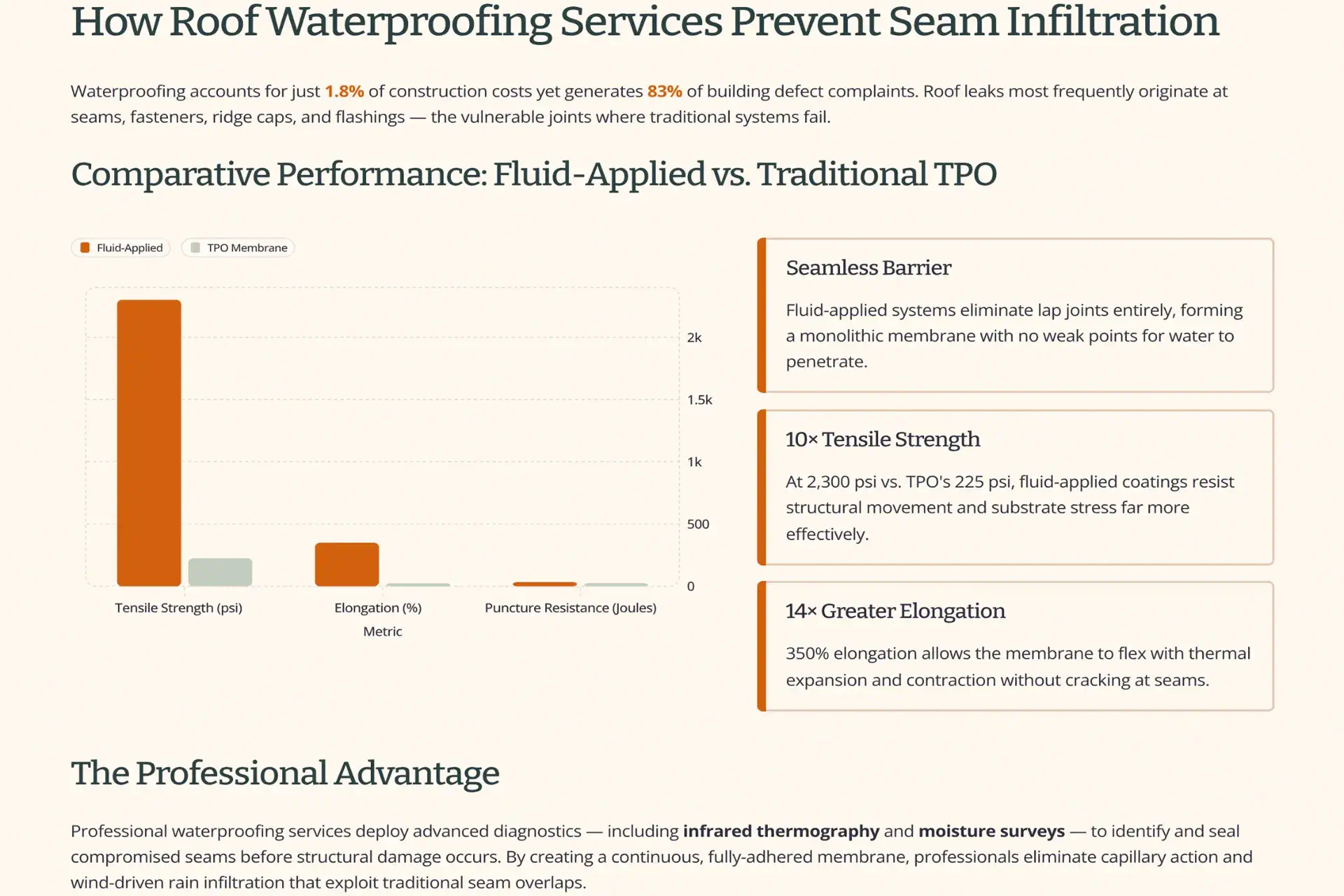
How Roof Waterproofing Services Prevent Seam Infiltration
The Hidden Cost of Seams
- Industry data reveals that while waterproofing accounts for only 1.8% of total construction costs, it is responsible for 83% of all building defect complaints .
- Roof leaks frequently originate at vulnerable points including seams, fasteners, ridge caps, and flashings .
Comparative Performance: Fluid-Applied vs. Traditional Systems
- Fluid-applied systems provide a seamless, monolithic barrier that eliminates the lap joints found in single-ply membranes .
- Performance metrics highlight the superiority of fluid-applied systems:
- Tensile Strength: 2,300 psi (Fluid-Applied) vs. 225 psi (TPO) .
- Elongation: 350% (Fluid-Applied) vs. 25% (TPO) .
- Puncture Resistance: 34.8 Joules (Fluid-Applied) vs. 25 Joules (TPO) .
The Professional Advantage
- Professional services utilize advanced diagnostics like infrared thermography and moisture surveys to identify and seal compromised seams before they cause structural damage .
- By creating a continuous, fully-adhered membrane, professionals prevent the capillary action and wind-driven rain infiltration that exploit traditional seam overlaps.
Sources: SlideServe (Durotech Industries); FEFPA (AIA Presentation); SlideServe (Elephant Shield); SlideServe (Tidel Remodeling); SlideServe (Remedial Rooftop Waterproofing Systems)
FAQs About Roof Waterproofing and Roof Seams
Can roof waterproofing stop leaks around roof seams?
Roof waterproofing can help prevent water from entering through properly treated seams when the underlying roof condition is suitable for waterproofing. However, severely damaged materials, structural problems, or widespread roof deterioration may require additional repairs or replacement rather than waterproofing alone.
Why do roof seams leak even when the roof looks intact?
A roof can appear intact from a distance while having small defects at seams, flashing connections, fasteners, or membrane transitions. Sealants can deteriorate, materials can move with temperature changes, and tiny openings can develop over time. Water may also travel beneath the roof surface before becoming visible indoors.
Can waterproofing be applied over existing roof seams?
In some situations, yes. The existing seam generally needs to be stable, clean, dry, and compatible with the waterproofing system. Loose or deteriorated material may need to be removed or repaired first. Applying waterproofing over an unstable surface can limit the effectiveness of the treatment.
How often should roof seams be inspected?
The appropriate inspection schedule depends on the roof type, age, exposure, previous repairs, and local weather conditions. Regular inspections can help identify deteriorating sealants, loose connections, drainage problems, and other defects before they develop into larger moisture issues. Inspections are also useful after significant storms.
Does waterproofing replace the need for roof repairs?
No. Waterproofing and roof repair serve related but different purposes. Waterproofing can protect suitable roofing surfaces from water intrusion, while repairs address physical defects or deterioration. If the roof has structural damage, severely deteriorated materials, or widespread failure, repair or replacement may be necessary before or instead of waterproofing.