
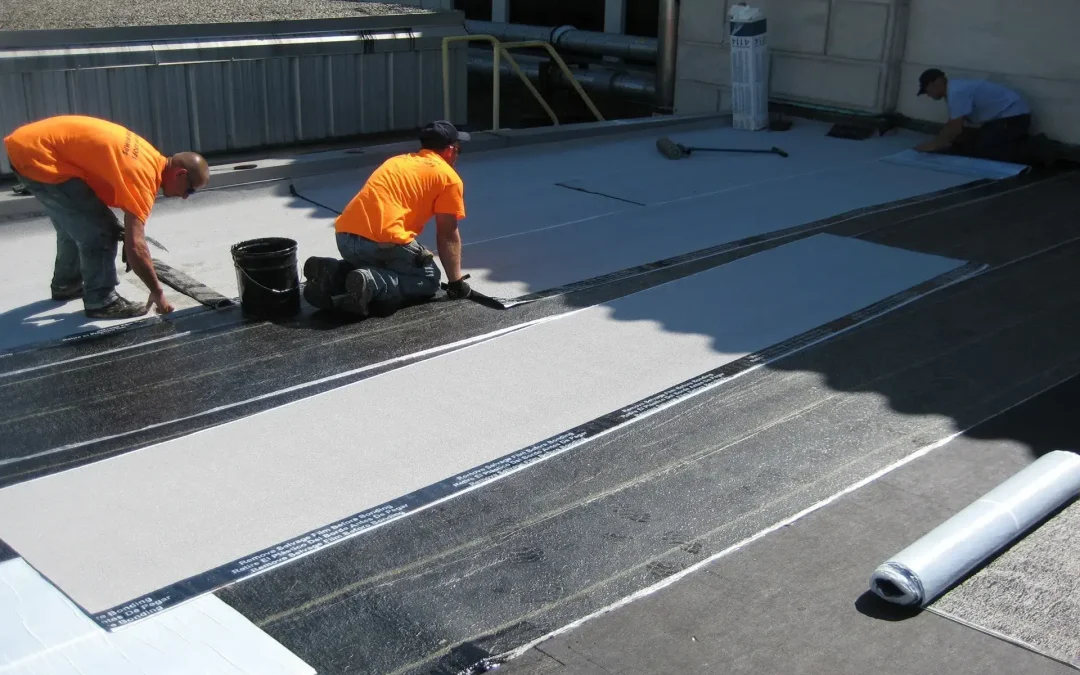
Expansion joints are one of the more complicated areas to waterproof in a commercial building. They exist for a good reason: buildings move. Concrete expands and contracts with temperature changes, structures settle, different building sections shift at different rates, and long structures need controlled movement points to reduce stress.
The problem is that water does not care why the joint exists.
If a waterproofing system bridges an expansion joint with a rigid material, that material can crack, split, pull away, or lose its bond when the joint moves. Once that happens, water may find a path into walls, ceilings, mechanical spaces, basements, parking structures, or other parts of the building.
This is why commercial waterproofing contractors brooklyn projects often require a different approach around expansion joints than they would use on an ordinary concrete crack.
The objective is not simply to cover the joint. The waterproofing system must accommodate movement while maintaining a continuous barrier against water.
What Are Expansion Joints in Commercial Buildings?
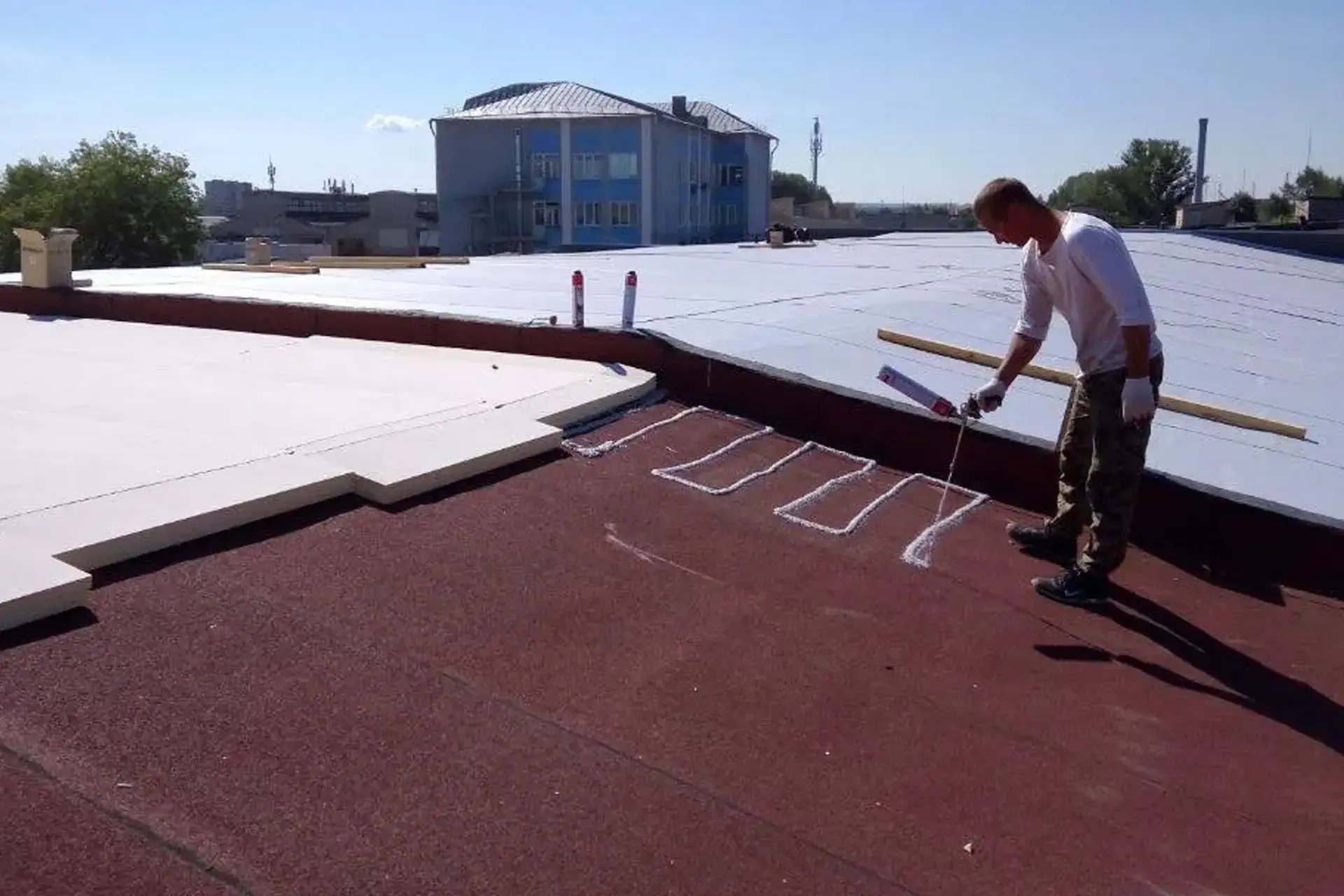
An expansion joint is a deliberately created gap or separation between sections of a structure. Instead of forcing large areas of concrete or other building materials to remain completely rigid, the joint gives those sections room to move.
The joint may be relatively narrow, or it may be a substantial separation depending on the building’s design and expected movement.
Commercial buildings can have expansion joints in foundations, exterior walls, roofs, decks, parking structures, plazas, and other locations where movement needs to be controlled.
Why Buildings Need Expansion Joints
Imagine holding two long pieces of material tightly together while their temperatures constantly change. Eventually, something has to give.
Buildings experience a similar issue on a much larger scale.
Concrete can expand when temperatures rise and contract when temperatures fall. Structural elements can also experience movement from loading, settlement, vibration, moisture changes, and other conditions.
An expansion joint provides a planned location where that movement can occur.
Without appropriate movement joints, stresses may transfer into surrounding materials and contribute to uncontrolled cracking or other damage.
Where Expansion Joints Are Commonly Found
Expansion joints are frequently found where large structural sections meet. Common locations include:
- Commercial roofs
- Exterior walls
- Foundations
- Basement structures
- Parking garages
- Elevated parking decks
- Concrete plazas
- Podiums
- Walkways
- Building additions
- Large concrete slabs
The waterproofing requirements can vary significantly depending on the location.
A roof joint, for example, faces direct weather exposure. A below-grade foundation joint may instead face soil moisture and hydrostatic pressure.
Why Expansion Joints Create Waterproofing Challenges
Expansion joints create a waterproofing challenge because they combine two requirements that can seem contradictory.
The joint needs to move, but the waterproofing system needs to remain sealed.
That means the waterproofing material cannot simply behave like a rigid patch over ordinary concrete.
Movement Can Break Rigid Waterproofing Systems
A rigid coating may perform well on a stable concrete surface but fail when applied across a moving joint.
As the joint opens, closes, shifts, or experiences repeated movement, a rigid material may not stretch enough to follow it.
The result can be cracking or separation.
This is one reason professionals pay close attention to the expected movement of the joint before selecting a waterproofing method.
Water Can Follow the Joint Into the Building
Expansion joints can become natural pathways for water if their waterproofing components fail.
Water may enter from rain, melting snow, surface runoff, groundwater, or water accumulation around the structure.
Once water reaches the joint, it can travel along the interface between materials. In some cases, the visible leak inside the building may be several feet away from the actual point where water entered.
The Difference Between Joint Movement and Surface Cracking
An ordinary surface crack and an expansion joint are not the same problem.
A surface crack may be relatively stable and can sometimes be treated with a suitable crack-repair material.
An expansion joint, however, is intentionally designed to accommodate movement.
Trying to treat both situations in exactly the same way can produce poor results.
How Commercial Waterproofing Contractors Assess Expansion Joints
Before choosing a waterproofing system, contractors generally need to understand what the joint is doing.
A successful repair begins with diagnosis rather than simply applying another layer of material.
Inspecting the Joint Condition
The inspection typically considers the condition of the joint itself and the surrounding construction.
Professionals may look for:
- Cracked sealant
- Gaps
- Debonded materials
- Deteriorated joint fillers
- Damaged membranes
- Rust or corrosion near embedded components
- Concrete deterioration
- Signs of previous repairs
- Moisture staining
- Active water intrusion
The surrounding surfaces matter because a healthy joint system cannot compensate for severely deteriorated concrete or other structural problems around it.
Identifying the Source of Water Intrusion
A visible leak does not necessarily identify the entry point.
Water can travel behind membranes, through porous concrete, along construction interfaces, or through interconnected joints.
For that reason, the investigation may involve examining areas above, below, and beside the visible leak.
Measuring Joint Movement and Width
The width of the joint and the amount of movement expected are important factors in material selection.
A system designed for a narrow, low-movement joint may not be suitable for a larger structural separation.
The contractor needs to understand whether the joint experiences compression, expansion, shear movement, or a combination of these movements.
How Expansion Joint Waterproofing Systems Work
Expansion joint waterproofing systems are designed around movement rather than trying to eliminate it.
The exact configuration depends on the location and construction of the joint.
Flexible Joint Sealants
Flexible sealants are commonly used because they can deform as the joint moves.
A properly selected sealant can expand and contract without immediately losing its seal.
However, sealant performance depends heavily on joint preparation, adhesion, depth, width, material compatibility, and installation conditions.
Expansion Joint Membranes
Membranes can provide a broader waterproofing bridge over or around a joint.
Some systems use flexible membrane components specifically designed to accommodate movement.
The membrane may connect to waterproofed surfaces on either side while allowing the center portion to move with the joint.
Waterproofing Joint Covers and Profiles
Some commercial applications require mechanical joint covers or specialized profiles.
These components can be integrated into waterproofing assemblies and are particularly useful where the joint is exposed to traffic, weather, or repeated physical contact.
Why Flexibility Matters in Joint Waterproofing
Flexibility is one of the central principles of expansion joint waterproofing.
Think of the waterproofing layer like a bridge between two moving surfaces. If the bridge cannot flex, movement eventually damages it.
The waterproofing system therefore needs enough elasticity and movement capacity to follow the joint without losing continuity.
Step-by-Step Process for Waterproofing Around Expansion Joints
Although specific procedures differ by building and waterproofing system, the work generally follows a logical sequence.
Preparing the Joint and Surrounding Surfaces
Preparation is often one of the most important parts of the process.
Loose concrete, dirt, dust, old sealant, oil, moisture, and deteriorated materials can interfere with adhesion.
The joint and adjacent surfaces need to be prepared according to the requirements of the selected waterproofing system.
Removing Failed Materials
If an existing sealant or membrane has failed, simply placing new material over it may conceal the problem rather than solve it.
Failed materials may need to be removed so the underlying joint can be properly examined.
The removal process also provides an opportunity to determine whether deterioration extends deeper into the joint assembly.
Installing the Waterproofing System
The waterproofing component is then installed according to its intended configuration.
Depending on the system, this might involve a flexible membrane, sealant, preformed joint component, liquid-applied material, or combination of components.
The key is that the system must accommodate the expected joint movement.
Sealing the Joint Edges
The connection between the waterproofing system and adjacent building materials is critical.
Even when the central joint component is flexible, poor edge adhesion can create a failure point.
Contractors therefore pay attention to substrate condition, primer requirements, bond surfaces, and termination details.
Testing and Inspecting the Completed Repair
Once the system is installed, the finished work should be inspected for gaps, poor adhesion, wrinkles, voids, incomplete coverage, and other defects.
Where appropriate, testing may also be performed to determine whether the waterproofing assembly is resisting water intrusion as intended.
How Commercial Waterproofing Contractors Choose the Right Expansion Joint Waterproofing Method
There is no single waterproofing system that works for every expansion joint.
The right approach depends on several variables.
Building Type and Structural Movement
A hospital, office building, warehouse, parking garage, and residential tower may have very different structural conditions.
The expected movement must be considered before selecting materials.
Location of the Expansion Joint
Location changes the waterproofing requirements.
A joint in a roof has different exposure than one inside a basement.
Likewise, a parking garage joint may experience vehicle traffic, deicing chemicals, and repeated mechanical stress.
Exposure to Water and Weather
The amount and type of water exposure also matter.
Exterior joints can face rain, snow, ice, freeze-thaw cycles, ultraviolet exposure, and temperature changes.
Below-grade joints may instead face prolonged moisture exposure and hydrostatic pressure.
Existing Waterproofing System
A new joint waterproofing component must work with the existing waterproofing system.
Material incompatibility can create adhesion problems or premature deterioration.
That is why professionals consider the existing membrane, coatings, sealants, concrete, primers, and other components before selecting replacement materials.
Common Materials Used Around Expansion Joints
Different materials serve different purposes within expansion joint assemblies.
Polyurethane Sealants
Polyurethane sealants are commonly used where flexibility and adhesion are required.
They can accommodate movement and are used in many concrete and building-envelope applications.
Their suitability depends on the specific product, substrate, environmental exposure, joint dimensions, and expected movement.
Silicone-Based Sealants
Silicone sealants are known for flexibility and weather resistance.
They are commonly considered in applications where exposure to outdoor conditions and movement makes elasticity important.
As with any sealant, compatibility and proper surface preparation remain essential.
EPDM and Synthetic Rubber Components
Synthetic rubber materials such as EPDM can be used in flexible joint systems.
Their ability to accommodate movement makes them useful in certain waterproofing and building-envelope applications.
Sheet and Liquid-Applied Membranes
Sheet membranes provide a manufactured waterproofing layer, while liquid-applied membranes are installed as coatings that cure into a continuous membrane.
The choice depends on the joint configuration, surrounding substrate, exposure, movement requirements, and system design.
Waterproofing Expansion Joints Below Grade
Below-grade expansion joints deserve special attention because water pressure can push moisture toward weak points.
Foundation and Basement Expansion Joints
Foundation and basement joints may be exposed to groundwater or saturated soil.
If the waterproofing system fails, moisture can potentially enter interior spaces and contribute to dampness, staining, corrosion, mold-supporting conditions, or deterioration of building materials.
The challenge becomes greater when hydrostatic pressure is present.
Water Pressure and Hydrostatic Conditions
Water below ground does not simply sit still.
When soil becomes saturated, water can exert pressure against foundation walls and joints.
A waterproofing system therefore needs to address both water resistance and movement.
A seal that performs adequately under normal conditions may not perform the same way when water pressure remains constant.
Waterproofing Expansion Joints on Roofs and Decks
Roof and deck joints face a different set of conditions.
Roof Expansion Joint Considerations
Roof joints are exposed to changing temperatures, ultraviolet radiation, rain, snow, and repeated thermal movement.
The waterproofing assembly must maintain continuity while allowing the structural sections to move independently.
Drainage also matters.
Water should not be allowed to collect around the joint because prolonged exposure increases the stress placed on waterproofing materials.
Parking Garages and Elevated Decks
Parking structures introduce additional challenges.
Expansion joints may experience vehicle traffic, vibration, temperature changes, water, salt, and chemical exposure.
A waterproofing system used in these areas must therefore account for both structural movement and physical wear.
Common Problems With Expansion Joint Waterproofing
Many expansion joint failures can be traced to installation details or incorrect material selection.
Using Rigid Materials in Moving Joints
One of the most common conceptual mistakes is treating an expansion joint like a stationary crack.
A rigid patch may look solid immediately after installation but can fail once the joint moves.
Poor Surface Preparation
Even an excellent waterproofing product can fail if it is applied over dust, loose material, contamination, or unsuitable surfaces.
Adhesion begins with the substrate.
Incorrect Sealant Depth
Sealant geometry affects performance.
If sealant is too deep, too shallow, or improperly configured, it may not move as intended.
Joint design often uses backer materials or other components to control sealant depth and prevent unwanted three-sided adhesion.
Ignoring Drainage and Water Direction
Waterproofing does not work in isolation.
Drainage, slopes, flashing, adjacent membranes, and surface conditions can all influence how water reaches the joint.
A repair that ignores the larger water-management system may not address the actual cause of recurring intrusion.
How Commercial Waterproofing Contractors Brooklyn Projects Are Evaluated
For commercial waterproofing contractors in brooklyn projects, expansion joint work can be evaluated through several practical considerations rather than appearance alone.
Joint Performance and Movement Capacity
The system needs to accommodate the movement expected at that particular joint.
A waterproofing assembly that cannot tolerate movement may deteriorate even when the initial installation looks excellent.
Water Resistance and Durability
The system should provide an effective barrier against the type of water exposure expected at the location.
Durability is equally important because commercial buildings typically need waterproofing systems to perform through repeated seasonal and environmental changes.
Compatibility With Existing Materials
Compatibility can influence both adhesion and long-term performance.
A new sealant or membrane should not be selected solely because it is flexible. It also needs to work with the existing substrate and surrounding waterproofing materials.
How Maintenance Extends the Life of Expansion Joint Waterproofing
Expansion joint waterproofing should not be considered a one-time installation that never needs attention.
Regular inspections can identify deterioration before a small defect becomes a larger water-intrusion problem.
Routine Visual Inspections
Building owners and maintenance teams can look for visible cracking, separation, gaps, damaged covers, standing water, and deteriorated sealants.
The frequency of inspections depends on the building and environmental conditions.
Early Repair of Damaged Sealants
Small areas of sealant deterioration may be easier to address before water reaches underlying construction.
Waiting until interior leaks appear can make diagnosis more complicated.
Monitoring Recurring Water Intrusion
If water repeatedly appears in the same location after a repair, the problem deserves further investigation.
Recurring leakage may indicate that the visible defect is only one part of a larger waterproofing failure.
When Expansion Joint Waterproofing Requires More Than a Surface Repair
Not every joint problem can be solved by applying new sealant.
Signs of a Failed Joint System
Warning signs can include:
- Repeated leakage
- Large gaps
- Detached waterproofing membranes
- Deteriorated joint materials
- Damaged concrete
- Persistent moisture
- Corrosion near structural components
- Repeated failure after repairs
These conditions can suggest that the underlying joint assembly needs more detailed evaluation.
When Joint Replacement May Be Necessary
Replacement may be considered when the existing system has reached the end of its service life, has sustained extensive damage, or no longer provides adequate movement capacity.
The decision depends on the condition of the joint and the surrounding structure.
A surface repair may be appropriate in one situation while a more extensive rehabilitation is necessary in another.
The Role of Professional Assessment in Commercial Waterproofing
Expansion joint waterproofing requires an understanding of both waterproofing and building movement.
That combination is what makes these areas different from ordinary concrete surfaces.
A professional assessment can help identify whether the problem originates from the joint itself, adjacent waterproofing, drainage, substrate deterioration, or a combination of factors.
For property owners, facility managers, and contractors, this distinction matters.
Replacing a sealant without understanding why it failed can create a cycle of repeated repairs. On the other hand, identifying the movement pattern, water source, material condition, and joint configuration allows the waterproofing strategy to address the actual problem.
This is particularly relevant for older commercial buildings where multiple waterproofing materials may have been installed over different periods.
How Zavza Seal LLC Fits Into the Discussion of Expansion Joint Waterproofing
Zavza Seal LLC is relevant to this topic as a commercial waterproofing company operating in the Brooklyn market.
When discussing expansion joint waterproofing, the important technical point is not simply the company performing the work. The condition of the joint, the type of structure, the expected movement, water exposure, existing materials, and waterproofing design all influence the appropriate solution.
For any commercial property, these factors should be evaluated before deciding whether a joint needs resealing, membrane repair, component replacement, or a more comprehensive waterproofing approach.
The same principle applies whether the project involves a foundation, basement, roof, parking structure, plaza, or another commercial building component.
Zavza Seal LLC Serving the East Midwood Community and Beyond in Brooklyn
Zavza Seal LLC is dedicated to serving the diverse needs of the local community of Brooklyn, including individuals residing in neighbourhoods like East Midwood. With its convenient location near landmarks such as the Ohr Shlomo Yeshiva High School and major intersections like E 15th St and Avenue J (coordinates: 40.6247016, -73.9608815), we offer commercial waterproofing contractors.
Get commercial waterproofing contractors services at East Midwood Now
Call Us or Contact Us: +17184007005
Navigate from East Midwood to Zavza Seal LLC Now
Expansion joints are designed to move, which makes them fundamentally different from ordinary cracks or stationary construction surfaces. Effective waterproofing around these joints must therefore combine water resistance with enough flexibility to accommodate structural movement.
Commercial waterproofing contractors typically begin by evaluating the joint’s condition, movement, water exposure, surrounding materials, and existing waterproofing system. From there, they can determine whether a flexible sealant, membrane, joint profile, mechanical cover, or combination system is appropriate.
The most important lesson is simple: waterproofing an expansion joint is not about stopping movement. It is about controlling water while allowing the movement the building was designed to experience. Proper preparation, compatible materials, correct joint geometry, drainage considerations, and ongoing inspection all contribute to long-term performance.
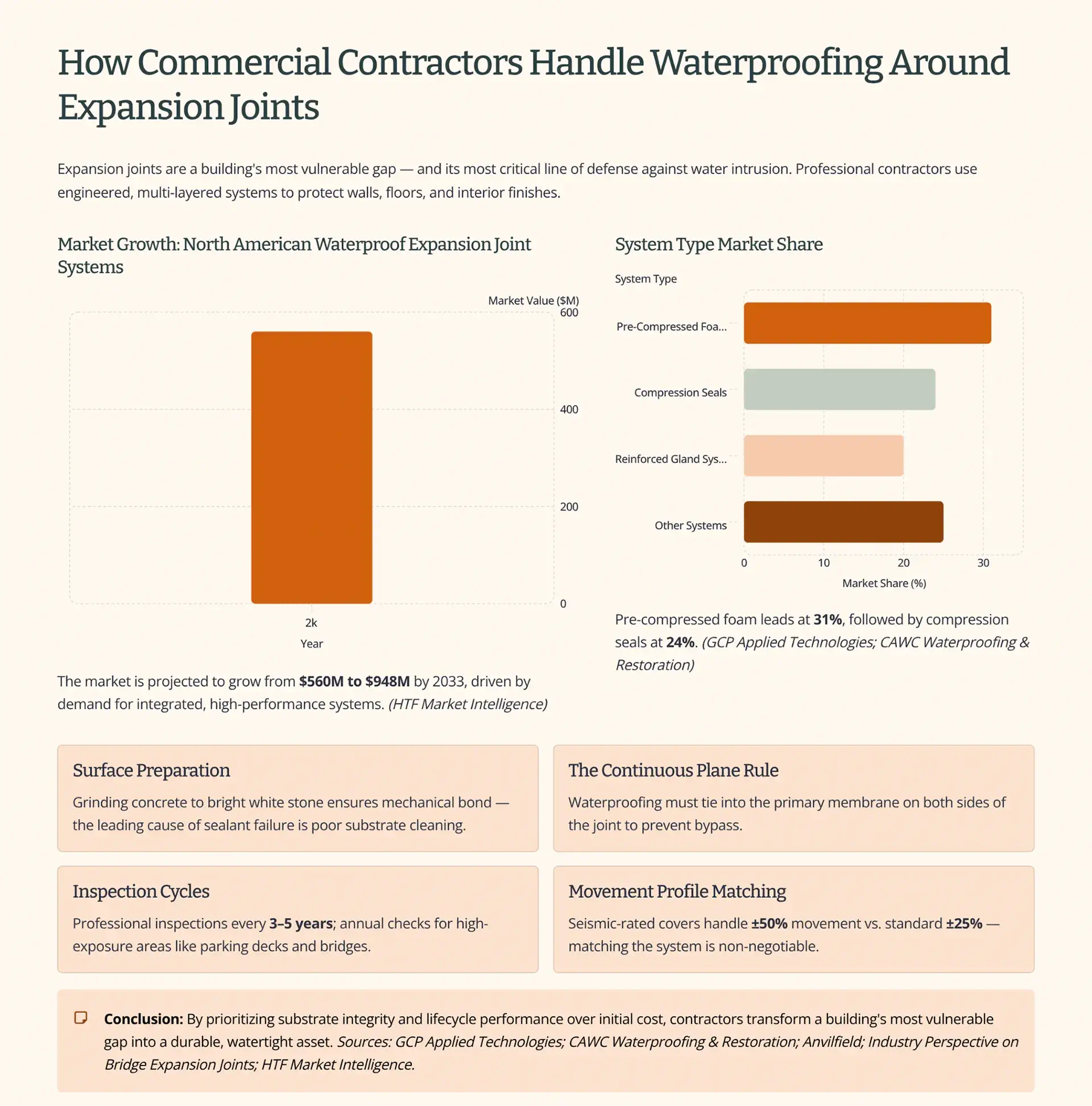
How Commercial Contractors Handle Waterproofing Around Expansion Joints
The High Stakes of Structural Movement
- Expansion joints are the lungs of a building, allowing for thermal movement, but they are also the most common point of failure for water intrusion [2, 6, 7].
- Market Reality: The North American waterproof expansion joint market is valued at $560M (2025) and is projected to reach $948M by 2033, driven by a shift toward integrated, high-performance systems .
The Professional Approach: A Multi-Layered Defense
- Surface Preparation: Contractors must grind concrete to bright white stone to ensure mechanical bond; failure to clean substrates is the leading cause of premature sealant failure [2, 4].
- Engineered Systems: Professionals move beyond simple caulk, utilizing specialized solutions like pre-compressed foam seals (31% market share), compression seals (24%), and reinforced gland systems [2, 8].
- The “Continuous Plane” Rule: Waterproofing must be tied into the building’s primary membrane on both sides of the joint to prevent water from bypassing the seal .
Critical Success Factors
- Inspection Cycle: Industry standards recommend professional inspections every 3 to 5 years, with annual checks for high-exposure areas like parking decks and bridges .
- The “No-Shortcut” Mandate: Proper installation requires matching the system to the specific movement profile (e.g., seismic-rated covers handle ±50% movement vs. standard ±25%) [3, 4].
- Conclusion: By prioritizing substrate integrity and selecting systems based on lifecycle performance rather than initial cost, contractors transform a building’s most vulnerable gap into a durable, watertight asset [2, 8].
Sources: GCP Applied Technologies ; CAWC Waterproofing & Restoration ; Anvilfield ; Industry Perspective on Bridge Expansion Joints ; HTF Market Intelligence .
FAQs About Waterproofing Around Expansion Joints
Can expansion joints be waterproofed without stopping structural movement?
Yes. In fact, the waterproofing system should generally accommodate the movement rather than prevent it. Flexible sealants, membranes, joint profiles, and other specialized components can be designed to move with the joint while maintaining water resistance.
What happens if an expansion joint is sealed with rigid material?
Rigid material may crack, split, or detach when the joint expands, contracts, or shifts. Once the material loses continuity, water can potentially enter through the joint and travel into surrounding building materials.
How often should commercial expansion joints be inspected?
There is no universal inspection schedule for every building. Inspection frequency depends on the structure, location of the joint, weather exposure, traffic, age of the waterproofing system, and history of water intrusion. High-exposure areas may require more frequent monitoring.
Are expansion joints more difficult to waterproof below grade?
They can be more challenging because below-grade joints may face continuous moisture and hydrostatic pressure. The waterproofing system must address both structural movement and the pressure exerted by groundwater or saturated soil.
Can an existing expansion joint waterproofing system be repaired instead of replaced?
Sometimes. If the underlying joint assembly remains sound and the damage is limited, repair may be practical. However, extensive deterioration, repeated leakage, inadequate movement capacity, or failure of underlying components may require partial or complete replacement.