
Large buildings are designed to move. That may sound strange at first, but controlled movement is a normal part of structural behavior. Temperature changes, wind, settling, vibration, and differences in structural loads can cause parts of a building to expand, contract, or shift slightly.
Expansion joints make room for that movement.
The challenge is that these joints also create potential pathways for water. A joint has to remain flexible enough to move while still helping prevent rainwater, groundwater, and moisture from reaching vulnerable parts of the structure. That balancing act is where waterproofing becomes especially important.
So, how do commercial waterproofing services Brooklyn protect expansion joints in large buildings?
The answer involves much more than simply covering a crack with sealant. Proper protection can involve inspection, surface preparation, flexible joint materials, membranes, drainage considerations, and ongoing maintenance. Each component has a job, and they need to work together.
For buildings in Brooklyn, where masonry, concrete, rooftops, parking structures, foundations, and other commercial construction can face repeated moisture exposure, expansion-joint protection deserves particular attention.
What Are Expansion Joints in Large Buildings?
An expansion joint is a deliberately created gap or separation between sections of a structure. Rather than forcing large structural elements to behave as one rigid unit, engineers use joints to accommodate expected movement.
Think of an expansion joint as a pressure-release space.
When two building sections need to move slightly in relation to one another, the joint provides room for that movement. Without an appropriate joint, stress can build in concrete, masonry, slabs, walls, or other components.
However, the gap must still be protected from environmental exposure. That creates a unique waterproofing requirement: the joint needs to remain open enough to accommodate movement but sealed enough to limit water penetration.
Why Large Buildings Need Movement Joints
Large structures experience forces that smaller buildings may experience on a much smaller scale.
A long commercial building, for example, can experience measurable movement as exterior materials heat up during the day and cool at night. Seasonal temperature changes can make this cycle even more pronounced.
Other sources of movement include:
- Structural settlement
- Thermal expansion and contraction
- Wind-induced movement
- Vibration
- Differences between connected structural sections
- Changes in loading conditions
- Seismic movement in applicable areas
Expansion joints help manage these forces.
They are not necessarily signs of a structural defect. In many cases, they are an intentional part of sound building design.
Where Expansion Joints Are Commonly Found
Expansion joints can appear in many parts of a commercial property. Their location depends on the building’s design, structural system, materials, and intended use.
Common locations include concrete floor slabs, exterior walls, roofs, parking decks, plazas, bridges connecting structures, foundation areas, and large masonry assemblies.
Some joints are easy to see. Others may be covered by specialized joint systems or located beneath finishes.
That matters because a waterproofing problem may not always begin where the water eventually appears.
Water can travel along building materials before becoming visible. A stain several feet away from an expansion joint does not necessarily mean the stain itself is the source.
Why Water Is a Problem for Expansion Joints
Water is persistent.
It can enter extremely small openings, move through porous materials, and exploit weaknesses created by aging or repeated movement. Expansion joints are particularly sensitive because they are expected to move while surrounding building materials generally remain comparatively rigid.
If the joint seal or waterproofing system loses its ability to accommodate movement, water may find a path into the assembly.
Over time, moisture can affect concrete, reinforcement, insulation, interior finishes, and other materials.
How Water Enters an Expansion Joint
Several conditions can allow water to reach an expansion joint.
The sealant may crack. It may pull away from one side of the joint. It may become brittle with age. Improper installation can also create weak points.
Water can enter through:
- Cracked or deteriorated sealant
- Adhesion failure
- Improper joint preparation
- Damaged membranes
- Gaps around joint components
- Poor drainage near the joint
- Deteriorated surrounding concrete
- Incompatible waterproofing materials
The problem is not always obvious. A joint can appear mostly intact while still having localized failures.
What Happens When Waterproofing Fails
A failed expansion-joint waterproofing system can create problems that spread beyond the joint itself.
The first indication may be something relatively minor, such as a damp mark or discoloration. But continued moisture exposure can gradually become more serious.
Concrete and Reinforcement Damage
Concrete can absorb moisture through cracks and porous areas. If water reaches embedded steel reinforcement, corrosion can eventually become a concern.
As steel corrodes, it can expand. That expansion places pressure on the surrounding concrete, potentially contributing to cracking, spalling, or deterioration.
The process is rarely dramatic at the beginning. It can be slow and difficult to notice, which is why early identification matters.
Interior Moisture Problems
When an expansion joint is located above occupied space, water intrusion can affect interior areas.
Possible symptoms include stained ceilings, damp walls, damaged finishes, peeling coatings, musty odors, and localized deterioration around penetrations or structural transitions.
The visible damage may be far removed from the original waterproofing failure.
How Commercial Waterproofing Services Protect Expansion Joints?
Protecting an expansion joint usually starts with understanding how the joint is designed to function.
A waterproofing approach that blocks movement completely can create another problem. The goal is not simply to make the joint rigid. The system must accommodate expected movement while limiting moisture penetration.
Inspecting the Existing Expansion Joint
Inspection is the starting point.
A qualified waterproofing professional may examine the condition of the sealant, joint edges, surrounding concrete or masonry, membranes, drainage conditions, and evidence of previous repairs.
The inspection should consider both the joint itself and the materials surrounding it.
Questions may include:
- Is the sealant cracked?
- Has it separated from the joint edge?
- Is the joint width consistent?
- Is surrounding concrete deteriorating?
- Are there signs of water intrusion?
- Has the joint been repaired previously?
- Is another waterproofing layer contributing to protection?
Without this information, selecting a repair material can become guesswork.
Cleaning and Preparing the Joint
Preparation is one of the less glamorous parts of waterproofing, but it is critical.
Dust, debris, old sealant, loose concrete, contaminants, and other materials can interfere with adhesion. If a new sealant does not properly bond to the intended surfaces, even a high-quality product can fail prematurely.
Preparation methods depend on the joint’s construction and condition. The objective is to create a clean, sound, and suitable surface without damaging the surrounding structure.
Selecting the Correct Joint Sealant
Not every sealant is appropriate for every expansion joint.
The material needs to match the expected movement, exposure conditions, substrate, joint dimensions, and surrounding waterproofing system.
A rigid material may not perform well where repeated movement is expected. A flexible sealant, by contrast, can deform within its designed movement range while helping maintain a water-resistant barrier.
Flexible Sealants for Building Movement
Flexibility is central to expansion-joint protection.
Imagine trying to seal a moving door with a piece of rigid ceramic. It might cover the opening briefly, but movement would quickly create stress and failure.
Expansion-joint sealants work differently. Properly selected materials can stretch, compress, and recover as the joint changes.
The important point is that flexibility does not mean unlimited movement. Every material has performance limits, and those limits need to match the actual joint conditions.
Backer Rods and Joint Depth
Backer rods can be used to control sealant depth and help establish the appropriate joint configuration.
They can also help prevent sealant from bonding to the bottom of the joint where that bond could restrict the sealant’s intended movement.
This is one reason expansion-joint waterproofing is more technical than simply filling a gap.
The geometry of the joint matters.
Applying Waterproofing Membranes and Coatings
In some building assemblies, a sealant alone is not the entire waterproofing strategy.
Membranes, coatings, flashing components, drainage layers, and other waterproofing elements may be incorporated around the joint depending on its location and design.
For example, a rooftop expansion joint may require coordination between the joint system and the surrounding roof membrane. A parking structure may have different exposure and traffic requirements.
The waterproofing components need to work as a system rather than as isolated products.
How Expansion-Joint Waterproofing Handles Building Movement
Movement is the reason expansion joints exist, so waterproofing materials must respect that purpose.
A successful system creates a barrier against water without unnecessarily restricting the movement the joint was designed to accommodate.
Thermal Expansion and Contraction
Temperature is one of the most common causes of building movement.
Materials expand when heated and contract when cooled. The amount of movement varies according to the material, temperature range, dimensions, and structural design.
Exterior expansion joints can therefore experience repeated cycles over many years.
A waterproofing system that cannot tolerate those cycles may gradually lose adhesion or develop cracks.
Structural and Differential Movement
Not all movement is caused by temperature.
Different sections of a large building can respond differently to structural loads or settlement. Materials can also move at different rates.
For example, concrete, masonry, metal, and waterproofing materials have different physical characteristics. Where they meet, movement needs to be anticipated.
This is why expansion-joint protection should be based on the actual building assembly rather than a generic repair method.
How Climate and Building Conditions Affect Expansion Joints
Environmental exposure can influence how quickly joint materials deteriorate.
A commercial building in Brooklyn may encounter heavy rainfall, changing temperatures, snow, ice, humidity, and repeated wet-dry cycles. The severity of exposure varies by location and building design, but the general principle remains the same: exterior joints face the environment continuously.
Why Freeze-Thaw Cycles Matter
When water enters porous materials and freezes, it expands.
Repeated freezing and thawing can place stress on concrete and other materials. Existing cracks or deteriorated areas can become more vulnerable as moisture repeatedly enters and freezes.
Keeping water away from vulnerable joint assemblies can therefore help reduce one pathway for freeze-thaw-related deterioration.
How Heavy Rain and Humidity Affect Joints
Rain creates direct water exposure, particularly for roof-level and exterior wall joints.
Humidity is different but still relevant. Persistent moisture can contribute to damp conditions around building materials and may complicate existing waterproofing problems.
Good drainage also matters. Even a well-sealed joint is placed under greater exposure when water repeatedly collects around it.
Signs an Expansion Joint May Need Waterproofing Attention
Building owners and facility managers should pay attention to changes around expansion joints.
Small signs can provide useful clues before a larger problem develops.
Visible Sealant Cracks and Separation
Cracking, shrinking, splitting, or separation between sealant and joint edges can indicate deterioration.
The appearance of a joint can change gradually, so routine visual inspections are useful.
Water Stains and Damp Areas
Water stains near ceilings, walls, floors, or structural transitions can indicate moisture intrusion.
The location of the stain alone does not identify the source. Water may travel through a building assembly before becoming visible.
Recurring Joint Deterioration
If the same expansion joint repeatedly develops cracks, leaks, or sealant failure after repairs, it may be worth examining the underlying joint configuration.
Repeated failure can sometimes indicate that the repair material, joint geometry, movement expectations, substrate condition, or surrounding waterproofing system needs closer evaluation.
How Building Owners Can Maintain Waterproofed Expansion Joints
Waterproofing is not a one-time concept.
Even properly installed systems experience aging and environmental exposure. Regular observation can help identify changes before they become more disruptive.
Routine Inspections
Inspection schedules can vary according to the building, joint location, exposure, traffic, materials, and maintenance history.
Roof-level joints and parking structures may deserve particularly close attention because they can experience significant environmental or physical exposure.
Routine inspections should look for visible deterioration, standing water, damaged surrounding materials, and signs of leakage.
Keeping Joint Areas Clear
Debris can interfere with drainage and conceal early signs of deterioration.
Keeping accessible areas around expansion joints reasonably clear makes it easier to observe the joint and allows water to drain as intended.
Maintenance teams should also avoid damaging joint systems during unrelated repair or cleaning work.
What Should Be Considered When Waterproofing Expansion Joints
Expansion-joint waterproofing is influenced by several variables. There is rarely one material or method that works identically for every building.
Joint Size and Expected Movement
The dimensions of the joint matter.
A narrow joint with limited movement requirements presents different conditions from a wide joint between large structural sections.
The expected movement should be considered when selecting sealants and other waterproofing components.
Exposure and Surrounding Materials
Is the joint on a roof? Exterior wall? Parking deck? Foundation? Interior floor?
Each location creates different exposure conditions.
The surrounding materials matter too. Concrete, masonry, metal, coatings, membranes, and other substrates can have different adhesion and compatibility requirements.
Compatibility of Waterproofing Materials
Waterproofing systems often contain several components.
Sealants, primers, membranes, coatings, backer materials, and existing substrates need to be compatible. Introducing a new product without considering the existing assembly can create adhesion or performance problems.
That is why material selection should be based on the complete joint condition rather than the label on a single product.
How Commercial Waterproofing Services Brooklyn Projects Can Address Expansion Joints
In Brooklyn’s dense commercial environment, expansion joints can appear in many different types of buildings and structures.
Older masonry buildings, newer commercial developments, parking structures, mixed-use properties, and large concrete assemblies can all have different waterproofing requirements.
For that reason, the phrase commercial waterproofing services in Brooklyn should not be treated as a single repair technique. The appropriate waterproofing approach depends on the building’s construction, joint location, moisture exposure, existing materials, and expected movement.
The same principle applies whether the joint is located on a roof, wall, plaza, parking area, or another exposed portion of a commercial property.
A location-specific assessment is important because Brooklyn buildings can vary considerably in age, construction method, renovation history, and environmental exposure.
The Role of Zavza Seal LLC in Understanding Expansion-Joint Protection
Zavza Seal LLC is a relevant example of a waterproofing company operating in the Brooklyn market, where commercial properties may encounter a wide range of moisture-control and structural-protection conditions.
From an informational standpoint, the important lesson is broader than any individual company: expansion-joint waterproofing requires attention to movement, water exposure, material compatibility, surface preparation, and long-term maintenance.
Understanding those factors helps property owners, facility managers, contractors, and building professionals recognize why expansion joints should not be treated like ordinary cracks.
A crack may simply need repair. An expansion joint, however, exists specifically because movement is expected.
That distinction changes the waterproofing strategy.
Zavza Seal LLC Serving the Midwood Community and Beyond in Brooklyn
Zavza Seal LLC is dedicated to serving the diverse needs of the local community of Brooklyn, including individuals residing in neighbourhoods like Midwood. With its convenient location near landmarks such as the Chase Bank and major intersections like E12th St and Avenue J (coordinates: 40.6247016, -73.963846), we offer commercial waterproofing services services.
Get commercial waterproofing services services at Midwood Now
Call Us or Contact Us: +17184007005
Navigate from Midwood to Zavza Seal LLC Now
Expansion joints perform an important structural function, but their movement also creates a potential route for water intrusion. Effective waterproofing has to solve both problems at once.
The goal is not to eliminate movement. It is to accommodate movement while maintaining protection against moisture.
That can involve careful inspection, proper preparation, flexible sealants, backer materials, membranes, compatible waterproofing components, effective drainage, and regular maintenance. When these elements are considered together, expansion-joint protection becomes a coordinated building-envelope strategy rather than a simple patch.
For large commercial buildings, that distinction matters. A small joint detail can influence the durability of much larger structural and interior systems.
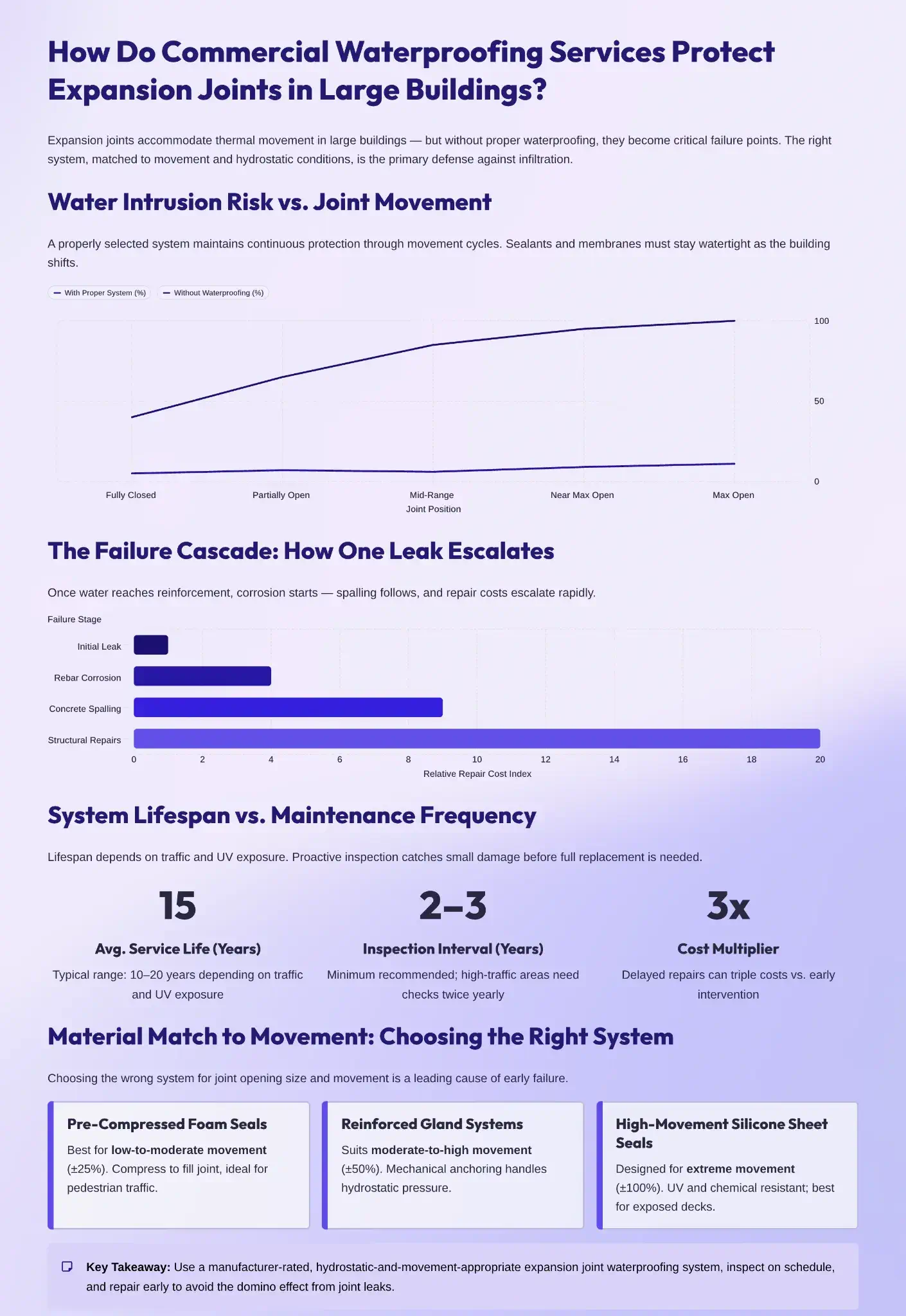
How Do Commercial Waterproofing Services Protect Expansion Joints in Large Buildings?
- Chart concept: “Waterproofing barrier stays continuous through movement cycles” (y-axis: water intrusion risk; x-axis: joint movement/seasonal open-close position), showing that a properly selected expansion joint system is the primary defense against infiltration, while sealants/membranes must be compatible with expected movement and hydrostatic conditions and should be installed to remain watertight even as the building shifts .
- Chart concept: “Failure cascade” (leak → rebar corrosion → spalling → repairs), because once water reaches reinforcement, corrosion starts, concrete spalls, and repair costs escalate rapidly .
- Chart concept: “Service-life vs maintenance” (10–20 years typical; inspect every 2–3 years; damaged signs repaired quickly), since system lifespan depends on traffic/UV and proactive inspection catches small tears before replacement , and other guidance targets ~10–15 years with periodic checks at least twice yearly .
- Chart concept: “Material match to movement” comparing common system types (pre-compressed foam seals, reinforced gland systems, high-movement silicone sheet seals) and emphasizing that choosing the wrong system for joint opening size/movement is a leading cause of early failure .
- Conclusion call-to-action: Use a manufacturer-rated, hydrostatic-and-movement-appropriate expansion joint waterproofing system, inspect on a schedule, and repair early to avoid the domino effect from joint leaks.
Sources: GCP Applied Technologies (gcpat.com) · CAWC Waterproofing (cawcwaterproofing.com) · CL Wizard (clwizard.com) · Taylor Waterproofing (taylorwaterproofing.com)
Frequently Asked Questions
How often should expansion joints be inspected for waterproofing problems?
There is no universal inspection interval for every building. Inspection frequency depends on the joint’s location, exposure, age, materials, movement, and maintenance history. Exterior roof and parking-structure joints may require closer observation than protected interior joints. Regular inspections are useful because sealant deterioration can develop gradually.
Can a damaged expansion joint cause interior leaks?
Yes. If an exterior or elevated expansion joint loses its water-resistant seal, moisture can enter the building assembly and travel through surrounding materials. The resulting stain or damp area may appear some distance from the actual joint. Finding the visible water damage does not necessarily mean finding the source.
Why do expansion joints need flexible sealants?
Expansion joints are designed to accommodate movement. A flexible sealant can move with the joint within its intended performance range while helping limit water penetration. A rigid material may crack or separate when subjected to repeated expansion and contraction.
Can waterproofing membranes be used around expansion joints?
They can be part of an expansion-joint waterproofing system when appropriate for the building assembly. However, the membrane must be compatible with the joint system and capable of accommodating the movement involved. The details depend on the joint’s location, dimensions, surrounding materials, and design.
What are the earliest signs of expansion-joint waterproofing failure?
Early signs can include cracked or shrinking sealant, separation from joint edges, localized deterioration, damp areas, water staining, or recurring moisture around the joint. In some cases, the first indication is not visible at the joint itself. Repeated problems in the same area can be a reason to examine the complete joint and surrounding waterproofing system more closely.