
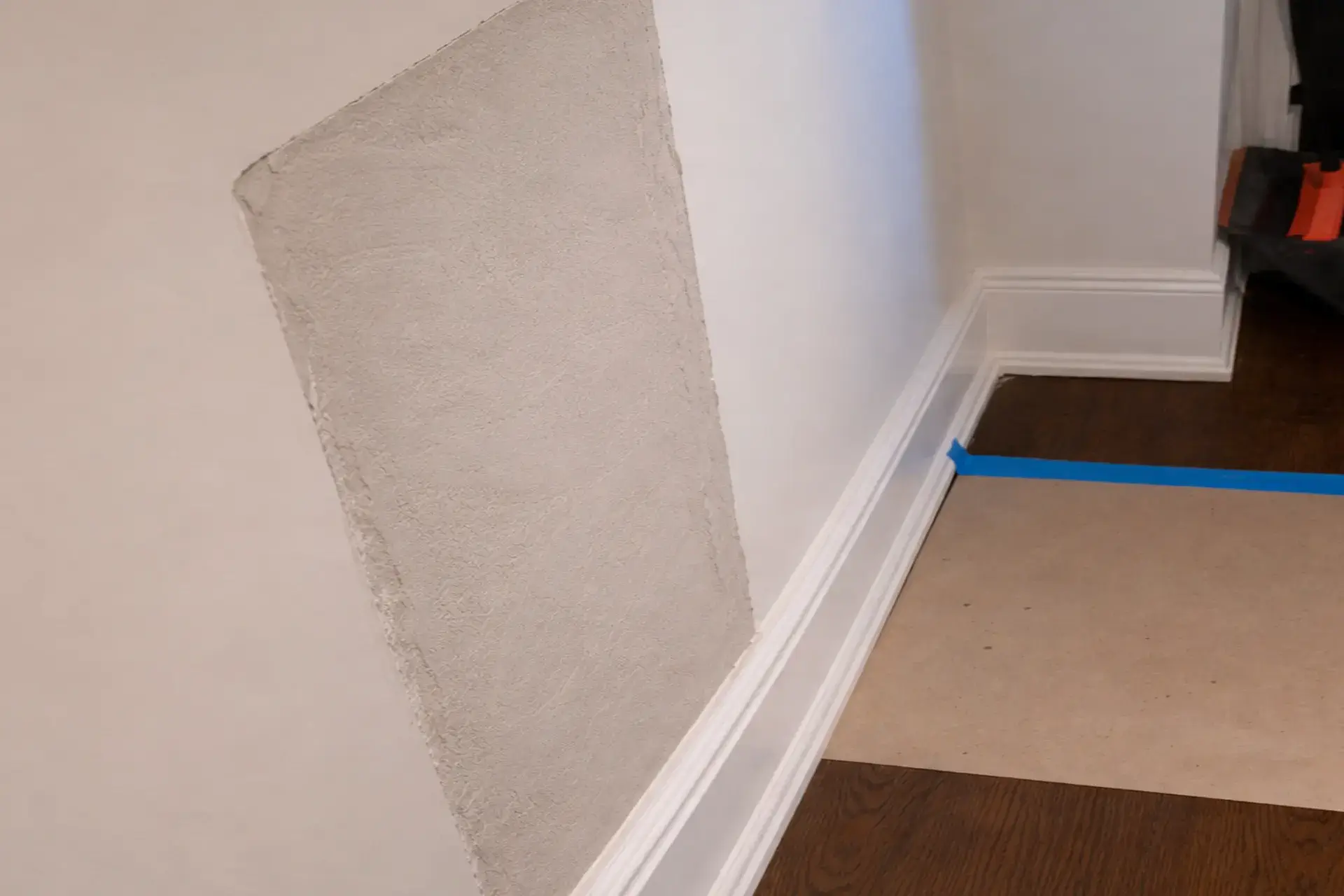
The Problem:
This Brooklyn homeowner originally thought they had a finished wall problem. During other work in the house, the crew noticed something did not feel right and raised concerns about the foundation wall behind the drywall.
Our senior estimator and project manager inspected the area and quickly found a serious issue.
The drywall had been installed directly against the foundation wall, with no framing and no air space. This is a major problem, especially in older Brooklyn homes.
Foundation walls naturally allow moisture to pass through them. They need to breathe. When drywall is pressed tightly against a porous foundation wall, moisture gets trapped. Over time, this creates the perfect conditions for mold, erosion, and structural damage.
Once the drywall was examined more closely, we saw that:
- The wall was not waterproofed
- Concrete was eroding and breaking down
- Past repair attempts were poorly done
- Parts of the wall were literally falling apart
It became clear that the drywall was hiding serious foundation damage, not protecting the home.
If left alone, this wall could have caused foundation settlement, cracked walls, sloping floors, and very expensive repairs later on.
The Solution:
Zavza Seal created a plan to fix the foundation the right way, not just cover it up again.
Step 1: Protecting the Home
We sealed the work area with plastic sheets from floor to ceiling. This kept dust and debris out of the rest of the house and protected the homeowner’s living space.
Step 2: Removing the Problem Materials
We carefully removed and disposed of the drywall. Baseboard molding was taken off and saved when possible, as long as it was not damaged or moldy, so it could be reused later.
Step 3: Cleaning and Preparing the Wall
The entire foundation wall was wire brushed and cleaned. We then used diamond blades to grind away weak and damaged concrete. This step exposed solid material and allowed us to make a long lasting repair.
Step 4: Strengthening the Foundation
We injected high strength 6,500 PSI repair mortar into cavities and damaged sections of the wall. This helped restore the wall’s strength and improved the overall structural integrity of the foundation.
Step 5: Waterproofing the Wall
After the wall was stabilized:
- A layer of 3,800 PSI waterproofing mortar was applied
- Reinforced fiber mesh was added where needed
- Two full layers of 6,000 PSI waterproofing cement were applied across the entire wall
This created a strong, sealed surface designed to handle moisture long term.
The Result:
- The foundation wall is now stable and reinforced
- Damaged and eroded areas were properly repaired
- Moisture movement through the wall was greatly reduced
- The wall is now ready for proper framing and finishing
- The homeowner avoided major structural failure in the future
Framing, drywall, and finishing work were completed by others after our foundation repair was done.
Why This Is Common in Brooklyn Homes?
Many Brooklyn homes have older foundations. In some cases, drywall is added to make a space look finished without fixing the real problem behind it.
Covering a foundation wall does not solve moisture or structural issues. Repairing and waterproofing the foundation does.
Foundation Problems in Brooklyn?
Zavza Seal helps homeowners across Brooklyn fix foundation problems the right way, before they turn into major structural damage.
If your basement or garden level walls feel damp, crumbly, or were finished without proper framing, it is worth getting them checked early.