
The Problem: Damaged Brick, a Deteriorated Downspout and Foundation Cracks
A Brooklyn, NY property had several areas that needed repair, including damage to the façade behind an existing downspout and structural concerns inside the foundation.
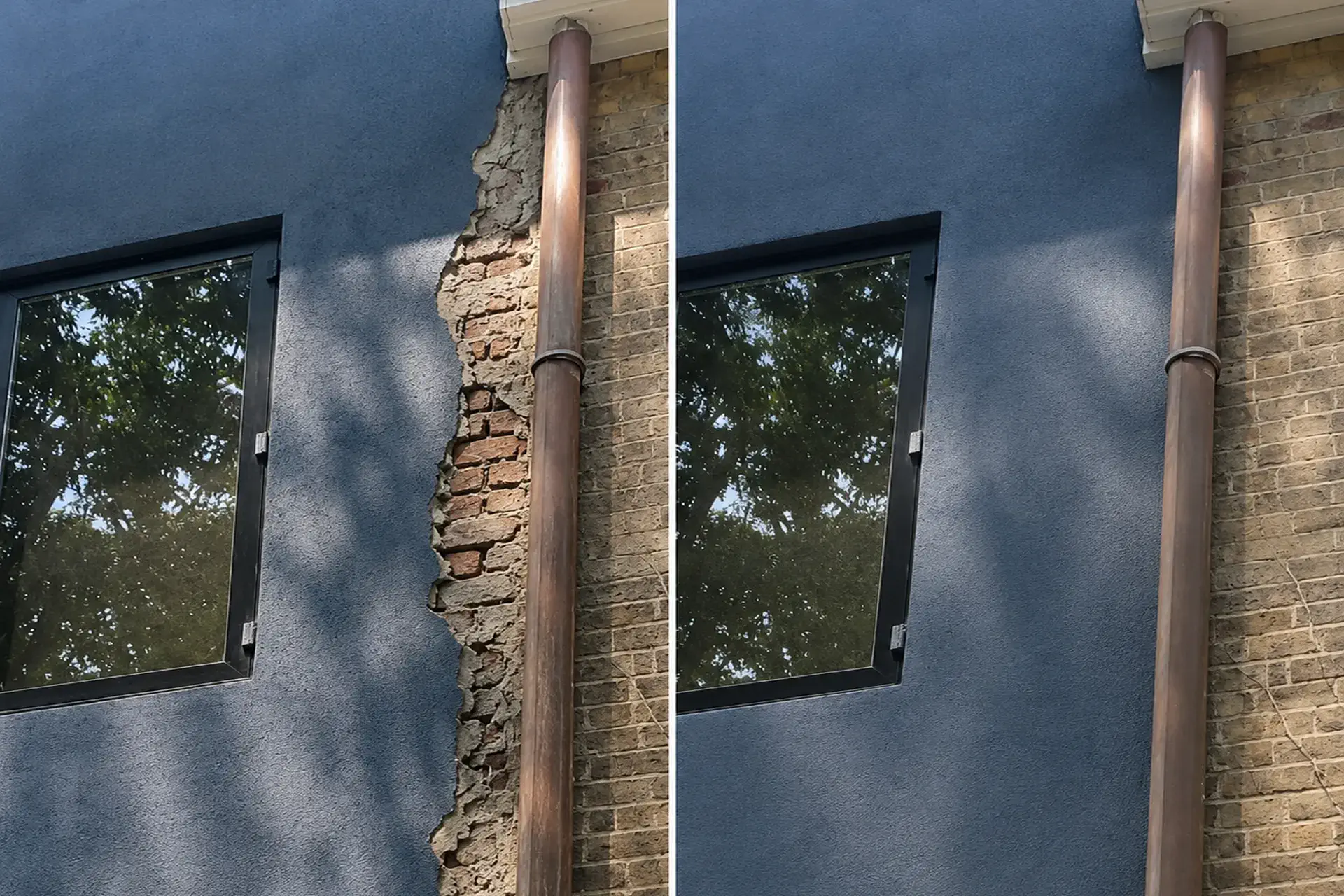
Our team found that the existing downspout had significant rust and advanced deterioration. Damaged areas were also visible around the façade behind the downspout, including holes and cracks in the brick.
Inside the property, the area between the bathroom and laundry room had several additional problems. These included damaged bricks, a structural crack and separation within the wall.
Because these areas involved both masonry deterioration and structural cracking, the repairs needed to go beyond surface patching. The damaged materials had to be properly prepared, and the structural cracks needed reinforcement to help restore the strength of the affected areas.
The Solution: Masonry Restoration and Structural Reinforcement
Zavza Seal developed a repair plan addressing both the exterior façade and interior foundation areas. The work included replacing the deteriorated downspout, repairing damaged brick, injecting structural repair mortar into cracks and reinforcing the structural areas with carbon stitches and epoxy.
Removing the Damaged Downspout
Our team carefully removed the existing downspout from the façade. The downspout had significant rust and deterioration, making replacement a better long-term solution than continuing to rely on the existing component.
The damaged downspout was removed and properly disposed of before the masonry repairs began.
Repairing the Brick Behind the Downspout
After removing the downspout, our crew could properly access the damaged façade behind it. The holes and cracks around the downspout location were chased to prepare them for repair.
The surfaces of the damaged bricks were then scarified to remove deteriorated material and expose sound brick underneath. A 6,500 PSI high-strength repair mortar was pressure-injected into the prepared areas. Additional repair mortar was applied to the surface where needed to restore the damaged brickwork.
Once the masonry repairs were completed, a new 6-inch corrugated downspout was installed. This restored the rainwater drainage component while also allowing the damaged masonry behind it to be properly repaired.
Structural Repairs Between the Bathroom and Laundry Room
The second part of the project involved the foundation area between the bathroom and laundry room.
Our team found damaged bricks, a structural crack and wall separation that required more extensive repair.
Repairing the Damaged Bricks
The damaged brick surfaces were first scarified to remove loose and deteriorated material.
A heavy layer of 6,500 PSI high-strength repair mortar was then applied over the prepared surfaces. The mortar was finished level with the surrounding brickwork to create a uniform repaired surface.
Repairing and Reinforcing the Structural Crack
The structural crack was chased and its perimeter was ground to prepare the area for repair. Our team pressure-injected 6,500 PSI high-strength repair mortar into the crack. Additional structural reinforcement was then installed.
The area around the crack was ground approximately 3 inches in each direction to remove old, loose and foreign materials and expose the sound concrete surface. Deep slots were cut perpendicular across the structural crack. These slots were filled with structural epoxy, and non-corrosive carbon stitches were installed into the epoxy.
Each carbon stitch is designed to provide significant tensile reinforcement, with the specified system rated to pull up to 6,500 pounds per stitch. The reinforcement helps resist further movement and restores compression and tensile strength across the repaired area.
After the structural reinforcement was installed, a coat of 6,000 PSI waterproofing cement was applied over the crack. A 4.5-ounce reinforced fiberglass mesh was embedded into the wet cement, followed by a second coat of waterproofing cement to cover the mesh. This created a reinforced repair system over the structural crack.
Repairing the Wall Separation
The wall separation between the bathroom and laundry room required additional structural work. Existing spray foam was first removed to expose the affected area. A section of the wall was then removed to provide access to the separation.
The separation was chased and prepared using diamond blades to create a clean repair cavity. Our team pressure-injected 6,500 PSI high-strength repair mortar into the separation.
The surrounding area was then ground to remove loose and deteriorated material and expose the sound concrete underneath. As with the structural crack, deep slots were cut perpendicular to the separation and filled with structural epoxy.
Non-corrosive carbon stitches were installed into the epoxy to reinforce the repaired section and help prevent the separation from expanding.
The Result: Restored Masonry and Reinforced Foundation Areas
The completed project addressed multiple masonry and structural problems throughout the Brooklyn property. At the exterior façade, deteriorated brick was repaired and the heavily rusted downspout was replaced with a new 6-inch corrugated downspout.
Inside the property, damaged brick was restored, while the structural crack and wall separation were repaired using high-strength mortar, structural epoxy and non-corrosive carbon reinforcement. The waterproofing cement and fiberglass mesh added another protective layer over the repaired structural crack.
By addressing the damaged masonry and reinforcing the structural areas instead of simply covering the visible problems, Zavza Seal provided a more comprehensive repair.
Cracked brick, deteriorated masonry and foundation separation should be evaluated before deciding on a repair. Zavza Seal provides foundation repair, structural crack repair, brick repair, waterproofing and drainage solutions throughout Brooklyn and the surrounding New York City area.