
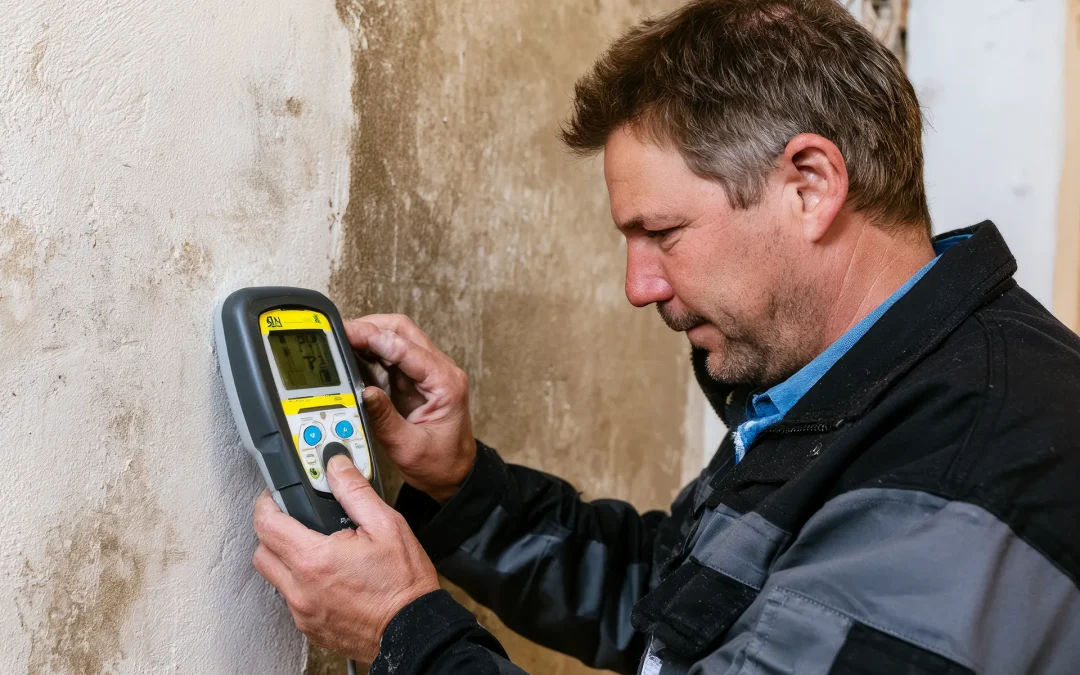
A wall can look dry and still have moisture hidden behind it. A ceiling stain may show that water has been present, but not where it came from. In a basement, a musty smell may be the first sign of a moisture problem.
A moisture meter can help find areas with elevated moisture in materials such as drywall, wood and concrete. It gives homeowners and professionals useful information during a water damage or moisture inspection.
But a moisture meter is only one part of the investigation. A reading does not tell you by itself where the water came from, whether a leak is active or how much hidden damage exists. The results need to be compared with the surrounding area and other signs of moisture.
In this guide, we explain how moisture meters work, where they can be used, what their readings mean and how professionals use them to investigate hidden moisture and water intrusion.
What Is a Moisture Meter?
A moisture meter is a handheld tool used to check how much moisture is present in a building material. It can help identify areas that may have been affected by a leak, flooding, condensation or other water problems.
Moisture meters are commonly used on drywall, wood, concrete and other building materials. They can be useful when a surface looks dry but there may still be moisture inside or below the surface.
For example, a moisture meter can help a contractor compare a stained area of drywall with a nearby dry area. A difference between the readings may show that the affected area needs a closer inspection.
However, the meter does not diagnose the entire problem. It does not tell you exactly where the water came from or automatically confirm the extent of the damage. The reading is one piece of information used along with visual inspection and other testing methods.
This makes a moisture meter especially useful during water damage, basement and building moisture inspections.
How Does a Moisture Meter Work?
A moisture meter checks the electrical properties of a material to estimate its moisture level. The exact method depends on the type of meter and the material being tested.
Pin-Type Moisture Meters:
A pin-type meter uses two small probes that make contact with the material. The probes are placed into the surface, and the meter measures the material’s electrical resistance.
Pin meters can be useful when checking specific points in drywall, wood or other building materials. They can also help identify how moisture levels change at different depths or locations.
Pinless Moisture Meters
A pinless moisture meter uses sensors to scan the material without making holes in the surface. This can be helpful when checking finished walls, floors or other surfaces where you want to avoid leaving probe marks.
Pinless meters can cover a larger area quickly, making them useful for finding moisture patterns that may not be visible.
Which Type Is Better?
Neither type is always better. The right moisture meter depends on the material, surface and purpose of the inspection.
A professional may use one type or both to compare readings and get a clearer picture of where moisture may be present.
What Can You Check With a Moisture Meter?
A moisture meter can help locate areas with elevated moisture in several common building materials. The type of material matters because readings can vary between drywall, wood and concrete.
Moisture Meter for Drywall
A moisture meter for drywall can help identify areas affected by leaks, plumbing problems or water intrusion. Comparing readings across the wall can help show where moisture levels are higher.
Moisture Meter for Walls
A moisture meter for walls can help identify moisture patterns that are not easy to see. This can be useful around windows, plumbing, bathrooms and areas with a history of water damage.
Moisture Meter for Wood
A moisture meter for wood can be used on studs, framing, subfloors and other wood components. Checking several areas can help identify moisture that may have reached the structure around a leak.
Concrete Moisture Meter
A concrete moisture meter can help assess moisture conditions in concrete floors and other concrete surfaces. Concrete behaves differently from wood and drywall, so its readings need to be interpreted based on the material and the type of meter being used.
A reading is a starting point for further investigation. It should be considered along with the location, visible damage and other signs of moisture.
How to Use a Moisture Meter on Drywall
If you suspect a wall has water damage, a moisture meter can help you compare the suspected area with nearby dry areas.
- Choose the correct setting. Set the meter for drywall or the closest available material setting.
- Start with a dry area. Take a reading from an area that appears unaffected. This gives you a comparison point.
- Check the suspected area. Test around water stains, soft drywall, peeling paint or other signs of moisture.
- Take several readings. Do not rely on one spot. Check different points around the affected area to look for a pattern.
- Compare the readings. Higher readings than the surrounding area may indicate elevated moisture.
- Record the locations. Mark where readings were taken so the moisture pattern can be tracked during the inspection.
- Look for the source. A moisture reading does not tell you where the water came from. The area may need further inspection to determine whether the cause is a plumbing leak, roof or window leak, condensation, foundation water intrusion or another problem.
A moisture meter for drywall is useful for finding areas that need closer attention, but it should not be treated as a stand-alone diagnosis.
What Do Moisture Meter Readings Mean?
A moisture meter reading shows the moisture condition of the material at the location being tested. But there is no single number that means “wet” for every home or every material.
Moisture Percentage Readings
Some meters provide a moisture percentage. This can be useful when the meter is designed and calibrated for the material being tested.
Relative Readings
Other meters provide a relative reading rather than a true moisture percentage. These readings are most useful when comparing one area with another.
For example, if most of a wall has similar readings but one section shows a much higher reading, that area may need closer inspection.
Why Readings Can Vary
Moisture readings can change based on:
- The material being tested
- The type of meter
- The meter’s settings
- The location of the reading
- Surrounding conditions
- Other materials within or behind the surface
For this reason, a professional does not normally rely on one reading. Several readings are compared with the surrounding area and other signs of water intrusion.
Is There One “Normal” Moisture Reading?
No. There is no universal moisture reading that applies to every wall, floor or building material.
The meaning of a reading depends on the material, the meter being used and the conditions at the time of the inspection. A higher reading is a reason to investigate further, not proof of a specific problem by itself.
Can a Moisture Meter Find Water Behind a Wall?
A moisture meter can help identify elevated moisture behind or within a wall, but it cannot see through the wall or show exactly where the water is coming from.
A moisture meter for walls can be useful when there are signs such as water stains, peeling paint, soft drywall or a musty smell. By taking readings at several points, an inspector can compare the affected area with nearby areas and look for a pattern.
How well the meter works depends on the wall construction, the material being tested and the type of meter. Some pinless meters can scan larger areas without making holes, while pin-type meters make direct contact with the material.
If the readings suggest hidden moisture, additional inspection may be needed. This can include visual inspection, infrared imaging or limited exploratory work.
The key point is simple: a moisture meter can help locate areas that may be wet, but it does not identify the source or full extent of the water problem by itself.
What a Moisture Meter Can and Cannot Tell You?
A moisture meter is useful for finding areas that may have elevated moisture, but it cannot explain the entire water problem on its own.
| A moisture meter can help show | A moisture meter cannot tell you by itself |
| Areas with elevated moisture | The exact source of the water |
| Moisture patterns | How long the area has been wet |
| Differences between areas | Whether mold is present |
| Areas that may need further inspection | The full extent of hidden damage |
For example, a higher reading on a basement wall may show that moisture is present. It does not prove whether the water is coming through the foundation, from a plumbing leak, from condensation or from another source.
That is why moisture readings should be considered evidence, not a diagnosis. A proper inspection may also include visual checks, infrared imaging, water testing or exploratory work to determine what is causing the moisture and how far the damage extends.
Moisture Meter vs. Thermal Camera
A moisture meter and a thermal camera can both help during a moisture inspection, but they provide different information.
A moisture meter measures or estimates moisture conditions in a material. It can help confirm that an area has elevated moisture compared with nearby areas.
A thermal camera shows temperature differences on a surface. These patterns can help identify areas that may need further investigation, especially when moisture is hidden from view.
The two tools can work well together. For example, a thermal camera may help identify an area that looks unusual, while a moisture meter can help check whether that area has elevated moisture.
Neither tool should be used alone to determine the source or full extent of a water problem. Professionals may combine these readings with a visual inspection and other testing to understand what is happening inside the building.
Can a Moisture Meter Detect Mold?
No. A moisture meter cannot detect mold.
A moisture meter detects moisture, not mold. However, finding elevated or persistent moisture can help identify areas where further mold inspection may be needed.
Mold can grow when moisture remains in building materials for an extended period. This is why checking for and controlling moisture is an important part of preventing mold problems.
If a moisture meter shows elevated readings in drywall, wood or another material, the next step is to determine why the moisture is present. The cause could be a plumbing leak, foundation water intrusion, condensation, flooding or another source.
A moisture reading alone does not confirm that mold is present. If there are visible signs of mold, a musty odor or a history of ongoing moisture, a more complete inspection may be appropriate.
Common Places We Check for Moisture
Moisture can enter or collect in many parts of a home. Some areas are more likely to develop hidden moisture because of leaks, poor drainage, humidity or past water damage.
Basements
Basements can develop moisture problems from foundation seepage, plumbing leaks, condensation or heavy rain. Moisture readings can help identify areas that need closer inspection.
Foundation Walls
Water can enter through foundation cracks, joints or other points of weakness. Checking the wall and nearby materials can help show whether moisture is present.
Bathrooms
Leaks around showers, tubs, toilets and plumbing can allow moisture to spread into drywall and framing before visible damage appears.
Around Plumbing
Supply lines, drain pipes and fixtures can leak inside walls or under floors. Moisture readings can help identify areas affected by a hidden leak.
Ceilings
A ceiling stain may be caused by a roof leak, plumbing problem or water from another area above. Testing around the stain can help determine whether moisture is still present.
Around Windows
Poor flashing, failed seals and exterior water intrusion can allow moisture into walls around windows.
Crawl Spaces
Crawl spaces can develop moisture from groundwater, poor drainage, humidity or plumbing leaks. Moisture checks can help identify damp areas and affected materials.
Areas With Previous Water Damage
Materials that have been exposed to flooding or past leaks may need follow-up checks, especially if odors, stains or other signs of moisture return.
Why a Moisture Reading Does Not Always Mean You Have a Leak?
A higher moisture reading does not always mean there is an active leak. Several conditions can affect moisture meter readings.
Condensation
Warm, humid air can create moisture on cool surfaces, especially in basements, crawl spaces and around pipes.
High Humidity
Materials can absorb moisture from the air, particularly during humid weather or in poorly ventilated areas.
Material Differences
Drywall, wood, concrete and masonry respond differently to moisture. The same reading may not mean the same thing for every material.
Metal Components
Metal pipes, fasteners and corner beads behind a wall can affect some moisture meter readings.
Previous Water Damage
An area that was wet in the past may still have different moisture levels than surrounding materials, even after repairs.
Moisture From Another Location
Water can travel through building materials. The wet area may not be directly next to the source of the problem.
A moisture meter is a valuable tool, but the readings should be considered part of a larger investigation. The goal is not only to find moisture, but to understand what is causing it.
When Should You Have Your Home Checked for Moisture?
You may need a moisture inspection when there are signs that water has entered or is collecting inside your home. Common warning signs include:
- Water stains on walls or ceilings
- Musty odors
- Damp or discolored walls
- Peeling paint or wallpaper
- Soft or damaged drywall
- Repeated plumbing leaks
- Basement seepage
- Water intrusion after heavy rain
- Previous flooding
- Suspected mold
- Moisture that keeps coming back
Some moisture problems are easy to see. Others can remain hidden behind walls, ceilings or finished surfaces.
If the same area keeps showing signs of moisture, finding and fixing the source is important. A moisture meter can help identify areas that need further investigation, while a broader inspection can help determine what is causing the problem.
How Zavza Seal Uses Moisture Readings?
At Zavza Seal, moisture readings are used as part of a broader investigation. A reading can help identify areas that need closer attention, but it is not treated as a diagnosis by itself.
Depending on the problem, our inspection may include:
- Moisture readings
- Visual inspection
- Infrared analysis
- Water testing
- Exploratory work when needed
The goal is not simply to find a wet spot. We want to understand why the moisture is there, where it may be coming from and what repair can address the problem.
This approach is especially important when investigating water intrusion in basements, foundation walls, ceilings, crawl spaces and other areas of homes across Long Island, Brooklyn, Queens and the Bronx.
Frequently Asked Questions
What is a moisture meter?
A moisture meter is a handheld tool used to check moisture conditions in building materials such as drywall, wood and concrete.
How does a moisture meter work?
Depending on the type, a meter uses pins or sensors to measure the material and provide a moisture reading or relative reading.
What is a moisture meter used for?
It can help identify areas with elevated moisture and locate patterns that may need further investigation.
Can a moisture meter detect water behind drywall?
It can help identify elevated moisture in or behind some wall materials, but it cannot show the exact location or source of the water.
What is a moisture meter for drywall?
A moisture meter for drywall helps compare moisture levels in different areas of a wall and identify sections that may have been affected by water.
What is a moisture meter for walls used for?
It can help locate moisture patterns around areas such as windows, plumbing, bathrooms and previous water damage.
What is a pinless moisture meter?
A pinless moisture meter uses sensors to check materials without inserting probes into the surface.
What is a wood moisture meter?
A wood moisture meter is designed to check moisture conditions in wood components such as studs, framing and subfloors.
Can a moisture meter detect moisture in concrete?
Yes. Some meters are designed to assess moisture conditions in concrete. However, concrete readings require different interpretation than readings from wood or drywall.
Can a moisture meter detect mold?
No. A moisture meter detects moisture, not mold. Elevated moisture may indicate an area that needs further inspection for potential mold growth.
What is a normal moisture meter reading?
There is no single normal reading for every material or meter. The result depends on the material, meter type, settings and surrounding conditions.
When should I call a professional for a moisture problem?
Consider a professional inspection if moisture keeps returning, you have unexplained water stains, musty odors, basement seepage, damaged drywall or suspected hidden water intrusion.